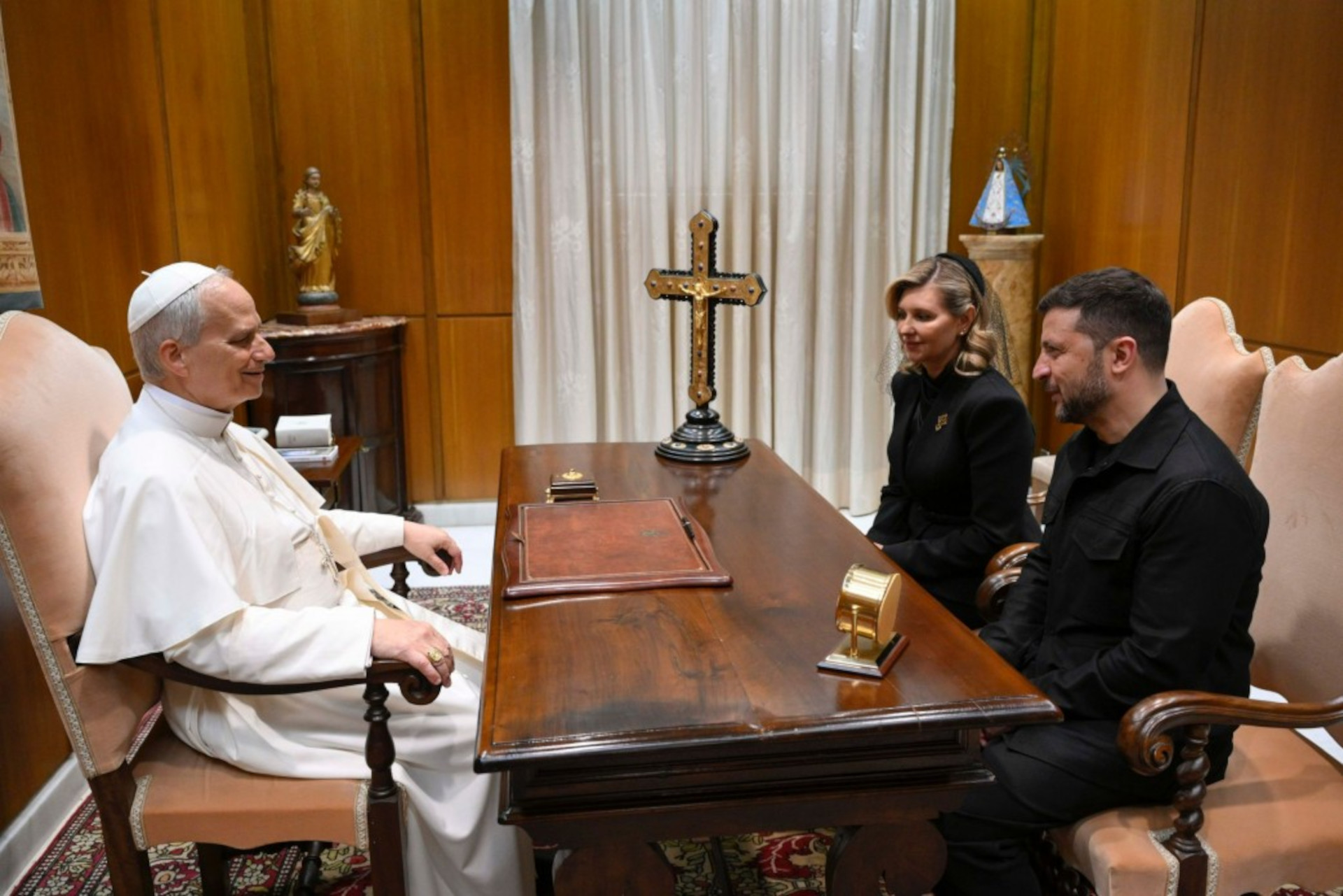
Following his inauguration Mass on May 18, Pope Leo XIV held an audience with Ukrainian President Volodymyr Zelenskyy and First Lady Olena Zelenska – the first audience with heads of state. Volodymyr and Olena expressed their gratitude for the Pope’s support of Ukraine and for his call for a just and lasting peace, the release of prisoners, and the return of children. How to achieve these goals as soon as possible was a central topic of the discussion during the audience. Zelenskyy emphasized that the authority and voice of the Holy See can play an important role in ending this war. Photo: Website of President of Ukraine
Marco Levytsky, Editorial Writer.
On May 8, 2025, Cardinal Robert Prevost became the first American in history to be elected pope. He took the name Pope Leo XIV for himself. Born in Chicago in 1955, he spent much of his life in Peru, where he joined the Augustinian mission in 1985. In November 2014, Pope Francis appointed Prevost apostolic administrator of the Diocese of Chiclayo in Peru, and a year later, he became the diocesan bishop. Pope Leo is considered to be more conservative than Pope Francis, his predecessor, on theological issues but is expected to continue advocating for social justice around the world. In fact, he deliberately chose the papal name Leo to continue the tradition of Pope Leo XIII, who served from 1878 to1903. That Pope was noted for championing the rights of the working classes at a time when industrialization and laissez-faire economics were causing great upheaval to, and imposing significant hardships upon, traditional agrarian societies. In Pope Leo XIII’s encyclical letter Rerum Novarum (“Of New Things”), written in 1891 and often considered the founding document of modern Catholic social teaching he called on the faithful to “save unfortunate working people from the cruelty of men of greed, who use human beings as mere instruments for money-making.” He argued that the worker’s right to a living wage took precedence over the free market.
In the same vein, the new American Pope Leo has criticized the Trump administration, particularly on social media. Before becoming Pope, he reposted articles and statements opposing US President Donald Trump’s immigration policies, including family separation and restrictions on DACA (Deferred Action for Childhood Arrivals). He also shared a commentary critical of Trump’s meeting with Salvadoran President Nayib Bukele regarding the suffering of migrants Trump had sent to the notorious CECOT prison in El Salvador that read: “Do you not see the suffering? Is your conscience not disturbed?” He has also responded to Vice President JD Vance’s invocation of a Christian principle to justify the mistreatment of immigrants by sharing a piece from the National Catholic Reporter headlined, “JD Vance is wrong: Jesus doesn’t ask us to rank our love for others.” This aligns with the positions Pope Francis has held. In a February 11 letter to the bishops of the United States, he wrote: “It ought to be clear that Catholics cannot support a rhetoric that demonizes immigrants as dangerously criminal simply because they have crossed the border in search of a better life for themselves and their families.”
But where Pope Leo XIV differs from Pope Francis is on foreign affairs, particularly in his response to Russia’s genocidal war against Ukraine. Where Pope Francis attempted to maintain a neutrality which reflected instead a definite pro-Russia bias, so far at least, Pope Leo has taken a much different approach. During his first Sunday prayer with the faithful on May 11, he stated: “I carry in my heart the suffering of the beloved Ukrainian people. May every effort be made to reach a true, just, and lasting peace as soon as possible. May all prisoners be freed, and may the children be returned to their families.” Following the appeal dedicated to Ukraine, Leo XIV also expressed his profound sadness caused by the events in the Gaza Strip, calling for an immediate ceasefire and the speedy delivery of humanitarian aid to the exhausted civilian population, as well as the release of all hostages. This too, differs in tone from the approach Pope Francis took, and is a message that must be taken to heart. For nearly two months Israel’s Netanyahu government has blocked food, fuel, water, and medicine from entering Gaza. The UN and humanitarian organizations have criticized this as a “weapon of war” and a violation of international law. Ukrainians are only too well familiar with the weaponization of food supplies since in 1932-1933 they endured the Holodomor, a genocidal famine that Soviet dictator Joseph Stalin inflicted on Ukraine that resulted in the agonizing starvation to death of millions. The weaponization of food, whether in the delivery of food to Gaza, or in the current war in Ukraine, Russian attempts to block Ukrainian grain headed to Africa on the Black Sea, must never be allowed. Neither war should have been initiated, either by Hamas or Russia, and no innocent lives should have been taken or imprisoned. All of this must stop.
What is significant about Pope Leo’s comments on the war in Ukraine is that they did not begin and end with the May 11 Regina Coeli address. He followed it up with a phone call with Ukrainian President Volodymyr Zelenskyy in what is the first known official call to a foreign leader by the Holy Father. “We deeply value his words about the need to achieve a just and lasting peace for our country and the release of prisoners,” Zelenskyy posted on X, saying he thanked the Pope for his support of Ukraine, adding they also discussed “the thousands of Ukrainian children deported by Russia.” Ukraine, Zelenskyy said, “counts on the Vatican’s assistance in bringing them home to their families” and informed the Pope that “the agreement between Ukraine and our partners (is) that, starting today, a full and unconditional ceasefire for at least 30 days must begin.” During the call, Zelenskyy invited Pope Leo XIV to make an Apostolic Journey to Ukraine, saying such a visit “would bring real hope to all believers and to all our people.”
“We agreed to stay in contact and plan an in-person meeting in the near future,” he said.
On May 15, the day after the Pontiff met with representatives from the Eastern Catholic Churches who arrived in Rome for a jubilee pilgrimage as part of the Holy Year 2025, he granted Patriarch Sviatoslav, head of the Ukrainian Greek Catholic Church, a personal audience in the library of the Apostolic Palace. At the outset of the meeting, His Beatitude Sviatoslav congratulated Pope Leo XIV on his election and thanked him for his first statements on behalf of Ukraine. “The Ukrainian people have already recognized you as the Pope of Peace. Last Sunday, we heard your words that the pain of the Ukrainian people is in your heart. Your call for true, just, and lasting peace is especially pertinent at this time, and your concern for the captive and deported children reflects your special paternal attention to the first victims of the war in Ukraine.”
He added that the Holy Father’s calls for an end to the war are incredibly important for the Ukrainian people. “They are a real spiritual balm for the wounded soul of the Ukrainian people, they keep us in the memory of the international community and preserve a name which they want to erase and deny our right to exist.”
Like Zelenskyy, Patriarch Sviatoslav also issued an invitation for an Apostolic Visit, “When Saint Pope John Paul II came to us, Ukrainians believed that communism would never return to our land. Today, we believe that the Pope’s visit will help stop the war in Ukraine,” said Sviatoslav. “The time and opportunity will surely be in God’s hands, but I consider it my duty to convey to you the invitation of millions of Ukrainians who are waiting for you,” he added.
While the Pope’s early comments are most encouraging, an Apostolic Visit would indeed have tremendous impact. The only time any Pope ever visited Ukraine was when Saint Pope John Paul II came in 2001 and beatified 27 Ukrainian martyrs. Among them were bishops, priests, nuns, and one layman who suffered and died for Christ under the communist scourge. That visit had a profound impact on the country. His presence reinforced Ukraine's independence and sovereignty, and reaffirmed its hard-earned place among the free nations of the world. But a visit today, would be infinitely more important. It would come at a time when Ukraine is struggling for its very existence against the efforts of a Russian state intent on reconstituting itself as the world’s greatest empire and colonial power (yet again) by swallowing Ukraine whole. Saint Pope John Paul II used his moral authority to bring down the evil Soviet Empire. Pope Leo XIV can use his to help bring about a just and lasting peace for Ukraine and inspire the free world to implement such other measures as might permanently frustrate Russia’s imperial ambitions.
Share on Social Media