Speakers draw parallel between that genocide and Russia’s genocidal war today
By Marco Levytsky, NP-UN Western Bureau Chief
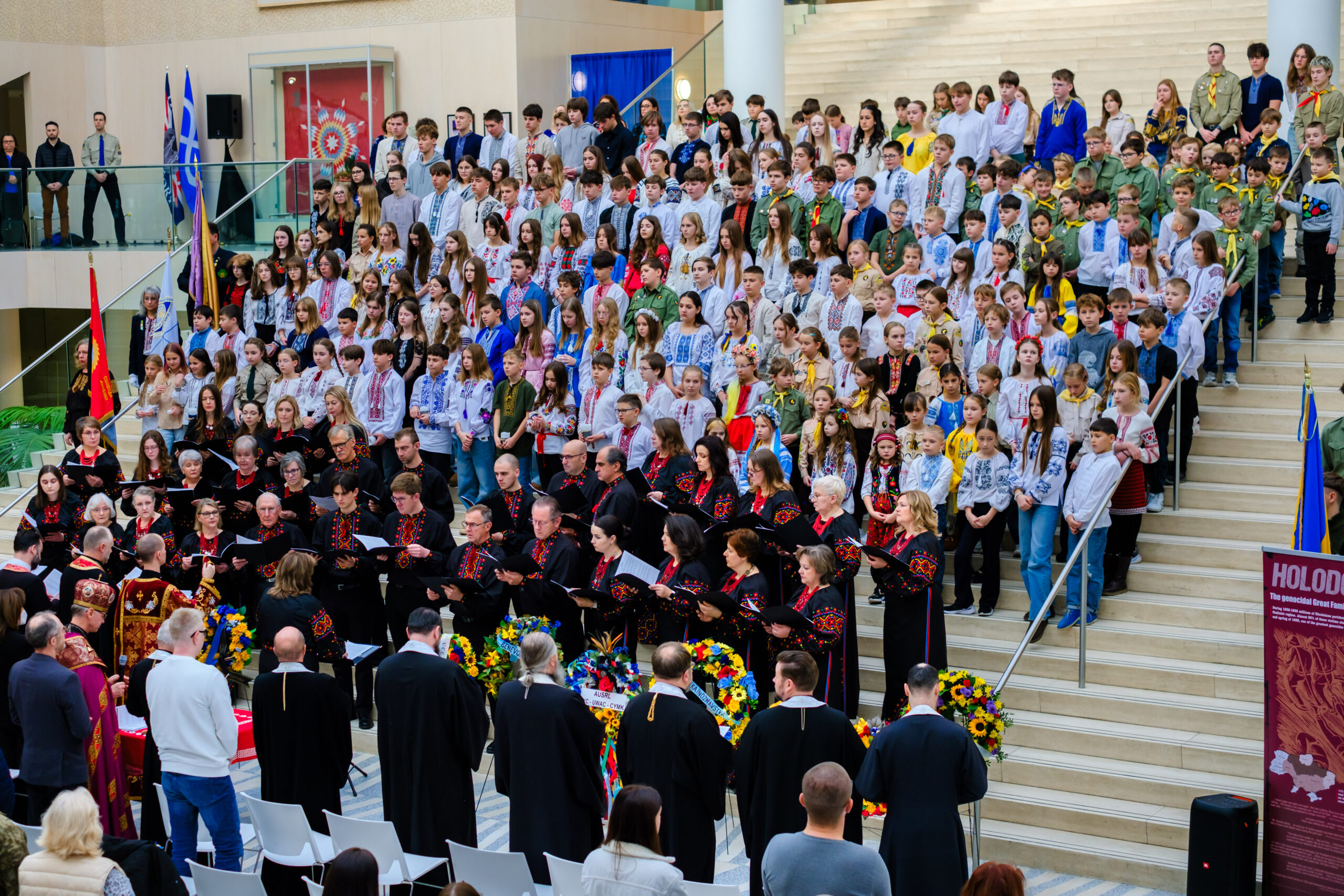
Over 500 people crowded Edmonton City Hall, November 22, to honour the memory of the millions of Ukrainians who were brutally starved to death in the Holodomor imposed by Soviet dictator Joseph Stalin in 1932-33.
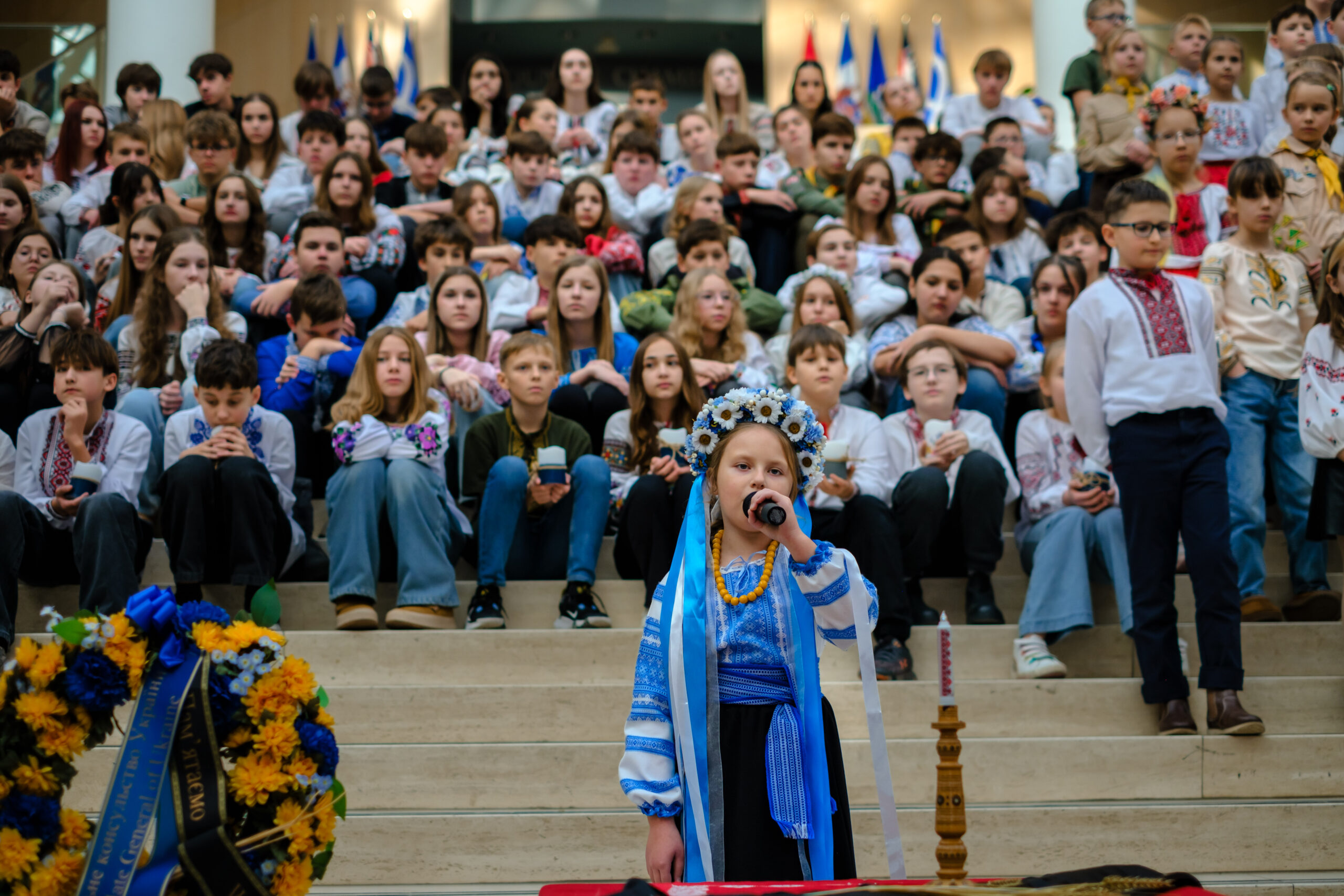
Ridna Shkola students at the commemoration
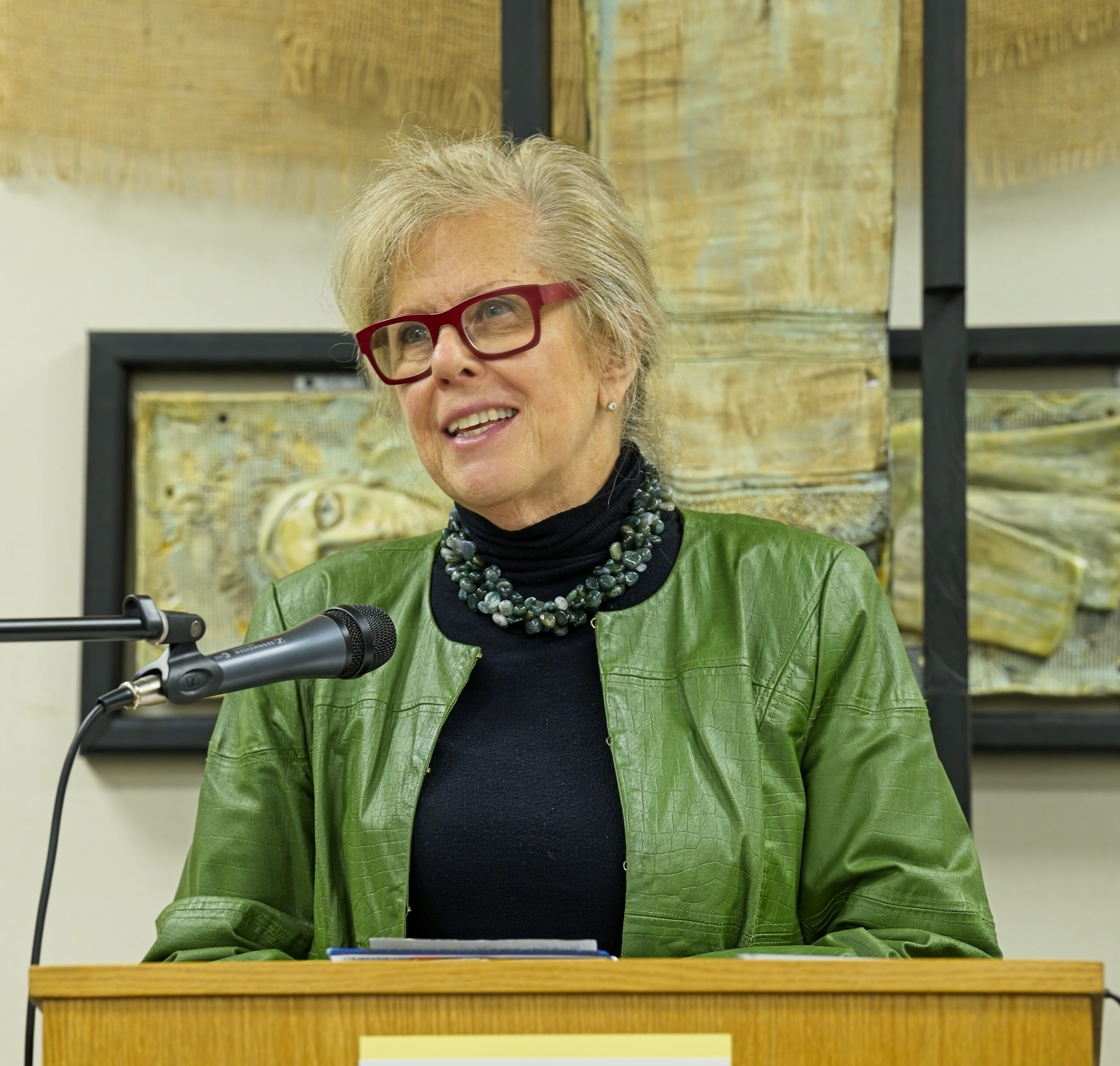
Keynote speaker Dr. Larysa Bilous, Research Associate at the Canadian Institute of Ukrainian Studies (CIUS) at the University of Alberta, drew a parallel between Stalin’s genocide and Russia dictator Vladimir Putin’s current genocidal war against Ukraine.
“As we gather here today, we cannot ignore the echoes of the past in the present. Ukraine again confronts a brutal war waged by a regime that denies its right to exist. Once again, we see assaults on civilians, deportations, attacks on cultural heritage, and the weaponization of food and energy. Once again, Ukrainians face winter with courage and resolve. History does not repeat itself exactly, but it echoes—and today, those echoes are painfully clear.
“But there is another echo as well: the echo of resilience. The very resilience that allowed Ukraine to survive famine, terror, and silence is the resilience that sustains Ukraine today. It is the resilience we honour when we gather at monuments, light candles, say prayers, and teach our children the history of the Holodomor,” she said.
Dr Bilous noted that the Holodomor was a reaction to the vibrant Ukrainian cultural renaissance that occurred in the 1920’s. This represented a profound threat to Stalin and when he launched the collectivization program “the very peasantry that supported Ukrainian cultural and political life—was targeted with special severity.”
“The Soviet leadership imagined, exaggerated, or deliberately constructed links between the peasantry and Ukraine’s cultural intelligentsia. Even if these connections were tenuous, the regime acted as if Ukrainian peasants and Ukrainian writers, scholars, teachers, and priests formed a single front of ‘nationalist resistance.’ The result was a dual assault: mass starvation in the countryside and the destruction of Ukrainian cultural life in the cities through arrests, executions, and censorship. These were not parallel events but interconnected tools of genocide,” she said.
The Holodomor also cleared the way for the return of imperial thinking.
“Ukrainian political identity was dismantled. Cultural elites were eliminated. The ‘elder brother’ narrative of Russian cultural superiority returned in full force. By the late 1930s, it was entirely acceptable—and even expected—for the leader of Soviet Ukraine not to speak Ukrainian at all.
Although the USSR denied the Holodomor, many people in Canada were aware of this atrocity. Canadian newspapers of the early 1930s did report on hunger in Soviet Ukraine. Across the country, Ukrainian Canadians organized dozens of protest meetings to draw attention to the catastrophe unfolding in their ancestral homeland.
And, despite the official denials of the Holodomor ordinary people preserved memories quietly and when the Soviet Union began to weaken in the late 1980s, the right to the Ukrainian language and the truth about the Holodomor became cornerstones of the democratic movement which led to independence.
Today at the University of Alberta, “we are working to ensure that the Holodomor is studied, understood, and remembered globally.”
“The Holodomor Research and Education Consortium is preparing to launch a Massive Open Online Course titled Famine as Genocide in the 20th Century: The Case of the Holodomor. This course, available worldwide on Coursera, will be free to all learners. It brings together leading international scholars, archival materials, survivor testimonies, and new research. Its goal is not only to teach the history of the Holodomor their greetings but to place it within a broader global context of famine as a tool of political violence. Education is one of the most powerful ways to honour the victims, counter denial, and preserve memory.
She closed by stating: “As we prepare to lay wreaths at the Holodomor monument, let us hold with us the memory of the millions who perished, the courage of survivors, the determination of Ukrainian Canadians who raised their voices in the 1930s, and the strength of Ukraine today. Let us remember that truth is stronger than silence, that memory is stronger than fear, and that justice begins with naming the past for what it was: genocide.”
Bringing greetings on behalf of Canada’s Head of State, King Charles III, Lieutenant Governor of Alberta Salma Lakhani noted that millions of innocent lives were lost to famine and oppression.
“Yet, even in the face of such suffering, the Ukrainian people have shown the world something extraordinary, an unbreakable spirit. From hardship has grown strength, from injustice has emerged a fierce commitment to freedom and dignity.
“This resilience is not only a testament to survival, it is a beacon of hope for all who cherish human rights and justice. Today, as we honor the victims of the Holodomor, we also celebrate the courage and pride that have carried the Ukrainian people through generations. Their story reminds us that truth will always outshine lies and that compassion and solidarity can overcome hatred and division,” she said.
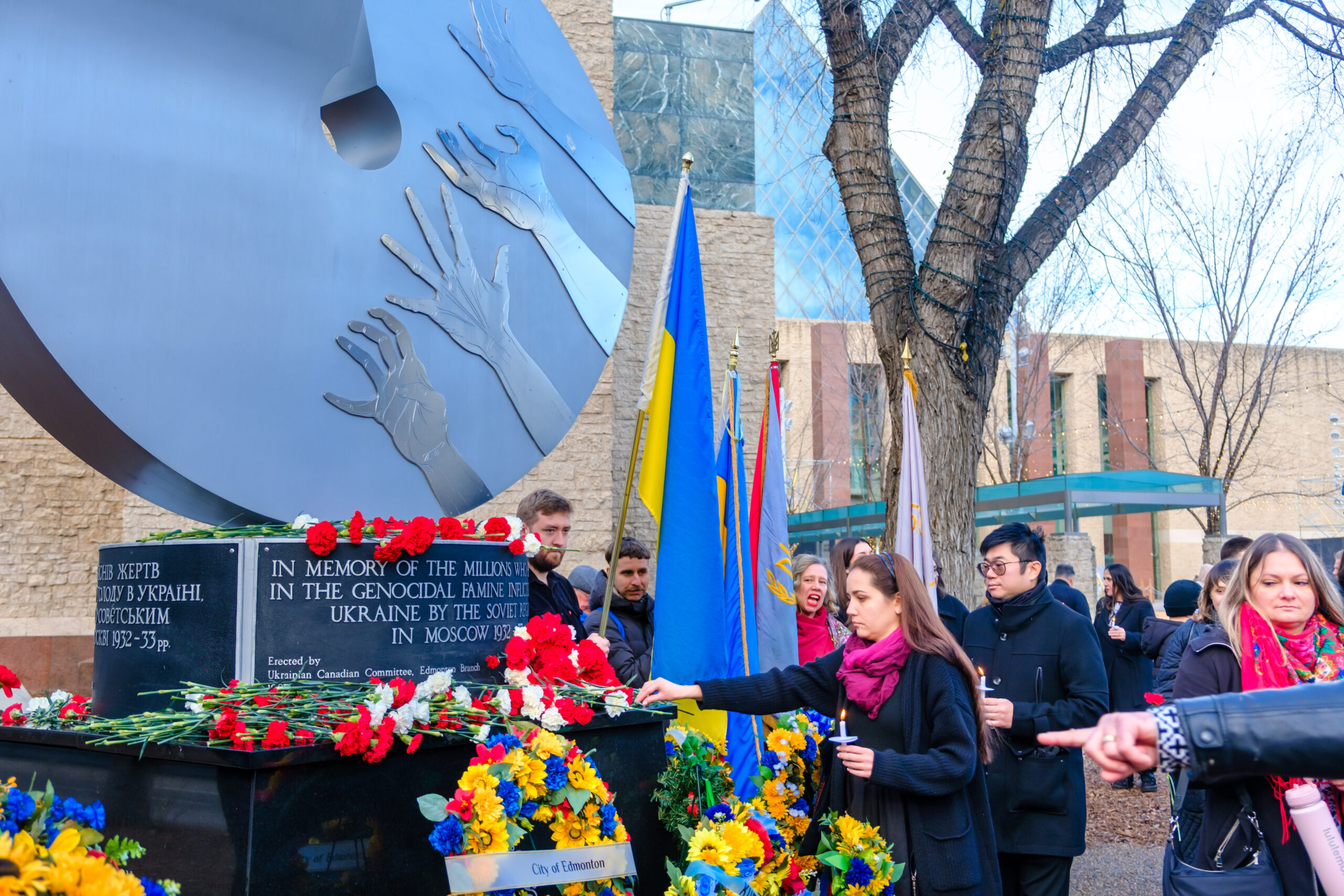
The laying of wreaths
Senator Paula Simons noted that the Holodomor is also her own family’s story as her Mennonite mother was born in Ukraine. “The Mennonites too suffered. Not at the scale of their Ukrainian neighbors, but in some Mennonite communities, as many as five to ten percent of the population starved in the years of the Holodomor. Others, great uncles of mine, were taken away by the Stalinists because the Holodomor was not just about starvation, it was also about taking people away to the Gulags, taking people away to the more immediate deaths.”
She added that “today, the people of Ukraine once again face an extraordinary threat with the same courage and the same resilience that they demonstrated in the early days of the 1930s. And then, as now, Edmonton serves as a cradle and a safeguard of Ukrainian culture and the strength and the joy and the beauty that is everything about Ukraine.”
Representing the Government of Canada, Eleanor Olszewski, Minister of Emergency Management and Community Resilience and Minister responsible for Prairies Economic Development Canada. Drew a parallel between the Holodomor and Russia’s genocidal war.
“The lessons remain, as every other speaker has said so far, painfully relevant today. The targeting of civilians, the denial of basic rights, the attempt to erase a people's identity are atrocities that must never happen again. Today, as Ukraine faces a new threat to its sovereignty, those lessons call us to action.
“Since Russia's illegal invasion in 2022, Canada has stood firmly with Ukraine. Our government has provided more than $22 billion in military, economic, humanitarian, and financial assistance, in equipment, and in long-term resilience projects to help Ukrainians defend their sovereignty, democracy, and way of life. We are clear and determined.
“Canada will not support a peace deal which demands territorial concessions from Ukraine, because Canada will always stand with Ukraine until the war is won, until Ukraine rebuilds, until Ukraine is free and sovereign,” she stated.
Speaking on behalf of the Official Opposition, Edmonton Griesbach MP Kerry Diotte, who was joined at the podium by Edmonton Manning MP Ziad Aboultaif and Sherwood Park—Fort Saskatchewan MP Garnett Genuis reiterated his own party’s support for Ukraine.
“We stood with Ukraine against Moscow‘s aggression. We stood with Ukraine when Putin launched his illegal full-scale invasion. We stand with Ukraine now. And we will always stand with Ukraine.
“I had the honour of travelling to Ukraine for the presidential election that elected president Zelenskyy in 2019. It was a truly inspiring moment for me and I’ll never forget the warmth of the Ukrainian people they treated us (Canadians) like gold.
“More recently, I was proud to take part in the Holodomor commemoration on Parliament Hill. I was joined by many of my Conservative colleagues.
“At the event in Ottawa, the Holodomor mobile classroom tour bus stopped by. The bus is touring around Canada to engage and educate students about the Ukrainian genocide. It’s a stark reminder of the atrocity that stole millions of Ukrainian lives — the lives we’re honouring here today. If you ever get a chance, take in the Holodomor bus it is very humbling and inspiring,” he said.
Representing the Government of Alberta, Jackie Armstrong-Homeniuk, MLA for Fort Saskatchewan–Vegreville and Parliamentary Secretary for Settlement Services and Ukrainian Evacuees stated as we honour victims of the Holodomor “we cannot ignore the echoes of history.”
“Ukraine faces another existential threat. Vladimir Putin’s invasion seeks to destroy Ukraine’s sovereignty and spirit—just as Stalin once tried. The courage of Ukrainians defending their homeland today reminds us that tyranny can never extinguish freedom.
“I call on all Albertans to remember the victims of Holodomor and to stand in solidarity with Ukraine. Let us support those who fight for democracy and independence, and ensure that the memory of this genocide is never erased. By doing so, we affirm that truth prevails over oppression, and freedom over tyranny,” she added.
Speaking on behalf of the Official Opposition, Edmonton McClung MLA Lorne Dach said the Holodomor was “starvation used as a weapon, a tool of repression and control, which led to indescribable suffering.”
“The goal was to break the people physically and erase their identity culturally. Now, by reflecting today on the horrific legacy of this tragedy, we try to ensure that history does not repeat itself. Let us honour the millions of Ukrainians who perished and also honour the survivors,” he said.
“On the fourth Saturday of every November, we are called to remember the victims of the Holodomor and to promote the fundamental freedoms of a democratic society.
“Ukraine is defending those same freedoms now in 2025. And tragically, impeding access to food and aid or denying a people the ability to produce their own food continues as a tactic of oppression and war around the world. We should never see it as anything else.
“And as I watch the children in the choirs here this afternoon, I'm reminded that another leader of the Soviet Union, the Russian dictator Putin, has stolen Ukrainian children during his invasion of Ukraine. Think about that. As we reflect today, we recommit ourselves to rejecting extremism, authoritarianism, and any force that tries to divide, control, or silence people,” he added.
Edmonton Mayor Andrew Knack said “the Holodomor is a lesson on how prejudice, oppression and misuse of power can lead to horrific consequences.”
“And while we acknowledge past events and vow never to repeat them, it's disheartening that we continue to see similar attacks across the world unfold before our eyes, including the illegal invasion of Ukraine by Russia. This is why now, more than ever, we need to stand up against violence and hate so we can continue to live in a safe and welcoming city. Canada was the first country to recognize the Ukraine famine as an act of genocide. The monument in Churchill Square is dedicated to victims of Holodomor and forever serves as a reminder of Ukraine's resiliency. I commend the Ukrainian Canadian Congress, Edmonton Branch, for bringing us together today and for continuing to provide a strong and united voice for the Ukrainian community. Your unwavering commitment to advocate for human rights is so inspiring.”
The commemoration started with a Prayer Service conducted jointly by His Most Reverend Bishop David Motiuk with Clergy of the Ukrainian Catholic Eparchy of Edmonton and Rev. Dr. Roman Shiyan, First Vice Chair with Clergy of the Western Eparchy, Ukrainian Orthodox Church of Canada. Responses were sung by the Ukrainian Dnipro Choir of Edmonton, conducted By Irena Szmihelsky. Dnipro also performed the poignant “Молитва” (Prayer) composed by Hanna Havrylets.
In her Opening Remarks Orysia Boychuk, President of the Ukrainian Canadian Congress – Alberta Provincial Council, also noted how history is repeating itself.
“Russia with its invasion is once again seeking to destroy Ukraine and its people. Today we mark 1,367 days since Russia’s full-scale invasion of Ukraine that began in 2022—4,293 days ago Russia invaded Crimea, This is renewed aggression, destruction, and unimaginable loss attempting to ethnically cleanse Ukraine and the Ukrainian people.”
Boychuk went on to note that the Ukrainian community in Edmonton played a pivotal role in uncovering and preserving the truth about the Holodomor by unveiling in 1983 the world’s first monument to the victims of the famine and paid tribute to the late Gene Zwozdesky, “whose leadership ensured the Alberta Legislature passed Bill 37 in one day at the legislature in 2008 to annually recognize the Ukrainian Famine and Genocide (Holodomor) Memorial Day Act.”
“The Edmonton Catholic School District has also been a leader, declaring the last Friday in November as Holodomor Memorial Day in 2011 and integrating Holodomor education into the Alberta curriculum for grades 11 and 12. Lesson plans are now available for Kindergarten through Grade 12, ensuring that future generations learn about this atrocity and the importance of standing against hatred and human rights violations” she added.
This was followed by the performance of “Хлібина надії” (A Loaf of Hope) by Grades 3-5 students of Ridna Shkola at the Ukrainian Catholic Parish of St. George, Principal: Olia Myc, Music Teacher: Olena Shevchuk.
Students of the Ivan Franko School of Ukrainian Studies, Principal: Liliya Sukhy, Music Instructor: Mariia Kosheliuk then sang “Holodomor”, Music and Lyrics by Anatoliy Salogub.
Anne Korownyk, widow of the late Leonid Korownyk, Edmonton’s last Holodomor survivor who passed away last year, read his poem “Remember the Holodomor”. While Korownyk was alive, his readings of his own poems were a staple of Edmonton’s commemorations.
Solomia Myc served as MC for the event.
“The word ‘Holodomor’ translates to ‘death by hunger,’ and it serves as a haunting reminder of the unimaginable suffering endured by the Ukrainian people. As we come together to reflect on this dark period, we recognize the importance of acknowledging historical truths, fostering remembrance, and promoting a collective commitment to preventing such atrocities from happening again,” she stated in her preamble.
In his closing remarks, UCC Edmonton President Dmytro Petrushchak thanked all who contributed to the event. At the conclusion attendees proceeded to lay wreaths at the monument.
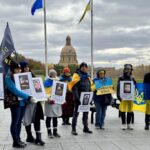
The commemoration also included an exhibition “The War Is Not Over” organized by the Edmonton Branch of the Ukrainian National Youth Federation.
The Organizing Committee was headed by Andrii Lytvynets and consisted of Dmytro Petrushchak, Liliya Sukhy, Diana Kotsyuba, Svitlana Varshavska and Kostiantyn Lutchenko.
Share on Social Media