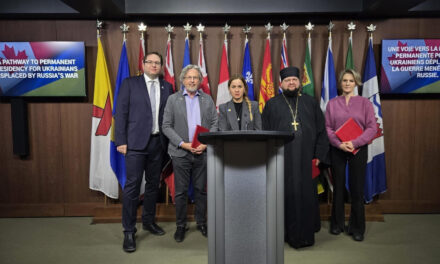
At the December 17 Press Conference. Left to Right: Ihor Michalchyshyn, Senator Stan Kutcher, Oksana Zubriy, Father Taras Kinash, Gala Darkina, Photo: Senator Kutcher’s Office
Marco Levytsky, Editorial Writer
On February 24, 2022, Russia launched a full-scale invasion of Ukraine. This caused a massive humanitarian crisis as some 12 million Ukrainians found themselves threatened or displaced by the onslaught and ultimately about six million Ukrainians sought refuge outside the embattled country. To meet this challenge, the government of Canada on March 17, 2022, authorized the Canadian Ukrainian Authorization for Emergency Travel (CUAET) visa program as a temporary measure to support Ukrainians and their immediate family members fleeing Russia’s genocidal war.
In total, the CUAET program enabled about 300,000 Ukrainians to come to Canada with temporary resident status and open work permits since February 2022. The program aimed to facilitate the rapid arrival of eligible Ukrainians, provided temporary accommodations upon arrival and transitional one-time financial support, and temporary access to federal government settlement services, such as language training. Ukrainians could apply for a three-year open work permit or study permit as part of their CUAET application before arriving in Canada. Alternatively, they could request a work or study permit at the port of entry or inside Canada once they arrived. Most CUAET visa holders in Canada have an open work permit which allows them to work for any employer in Canada.
Last year the government extended the eligibility period to apply for an extension of CUAET permits until March 31, 2026. The normal period of extension of work or study permits has been for a further three years from the date of approval. However, the federal government has terminated some of the support services previously provided to Ukrainian immigrants. As the March 2026 eligibility for extensions deadline approaches, and with no end in sight to the brutal Russian war being waged in Ukraine, the actual number of CUAET visa holders still wanting to extend their permits in Canada, according to the UCC projections, has declined to about 150,000. But those individuals who do want to extend their status have become highly concerned about their future. They eventually could face the possible loss of legal employment, and have already faced loss of access to some government or employer-sponsored job training and certification and other benefits that accrue with accumulated job experience, not to mention a likely future loss of access to health services if their status runs out without further renewals. In addition, many Canadian employers are reluctant to extend longer term employment opportunities to them because of the likelihood that their visa and work permits will expire. As a result, many Ukrainians are not able to maximize their income earning potential and end up in short term, lower paying positions.
If they are unable to support themselves, pay their taxes, and feed their families, these Ukrainians and their families, who since March 2022 have built connections and standing in their communities, and who in many cases, have no other place to now call home, could become a burden on our society. Many Ukrainians fear that they could be deported from Canada if they are eventually unable to renew their status within Canada. Canadian Border Services Agency currently has an Administrative Deferral of Removals in place for Ukraine due to the ongoing war in Ukraine. While this provides some comfort, it does not provide Ukrainians with the certainty that they can continue to support themselves and their families.
Two months ago the Ukrainian Canadian Congress submitted a briefing note for Immigration Refugees and Citizenship Minister Lena Metlege Diab to provide a pathway to Permanent Residence in Canada for eligible CUAET Visa holders and their families. The briefing note cited the precedent of the federal program for Canadian-bound Chinese refugees from Hong Kong, suggesting a similar program could be adopted for Ukrainian immigrants in Canada under CUAET.
The UCC briefing note also contained two major policy recommendations:
- That pursuant to the discretion granted to the Minister in section 25 of the Immigration and Refugee Protection Act (S.C. 2001, c. 27), the Minister approve a Temporary Public Policy (TPP) Pathway for Permanent Residence for Ukrainian citizens who are in Canada on a Canada Ukraine Authorization for Emergency Travel (CUAET) visa;
- That the Minister increase the number of provincial nominee allocations across Canada. This would allow provincial governments to develop streams designed to meet specific economic labour requirements. Many provinces are prepared to use the nominee allocations to provide Permanent Residency under their nominee programs but are not satisfied by the number of positions they are being allocated. Alberta Premier Danielle Smith has been particularly critical of the federal government noting that at one point Alberta had almost 10,000 nominee positions, which was cut down to 4,800, and later increased to 6,400. However there are anywhere from 20,000 to 30,000 people applying to be in Alberta, who have good jobs and good opportunities and support from their community, she says. The hope would be this could enable some provinces, like Alberta for example, to create some openings for Ukrainian immigrants in their provinces as part of their expanded number of approved immigration permanent resident opportunities under their Provincial Nominee Programs.
To date, the minister has not responded to the UCC’s briefing note prompting the UCC to hold a press conference with Independent Senator Stan Kutcher, on December 17, calling upon the minister to provide a pathway to permanent residency to Ukrainians displaced to Canada by Russia’s genocidal war of aggression and to do it now.
Joining Senator Kutcher were Gala Darkina, a Ukrainian newcomer with two children displaced to Canada by Russia’s war, who spoke about her experience having to leave her home in Ukraine and come to Canada; Father Taras Kinash, Priest of the Ukrainian Orthodox Church in Ottawa and spiritual advisor to scores of displaced Ukrainians; Ihor Michalchyshyn, UCC CEO, and Oksana Zubriy, Advisor on Ukrainian Affairs in Senator Kutcher’s office.
Senator Kutcher summed up the situation very appropriately: “The issue that the Government of Canada faces here, is, at its core – a moral one. Should we assist a group of people who have been displaced by a genocidal war and who have not only sought refuge here, but who have made Canada their home. The Minister can act should she choose to do so. We are hopeful that the Minister chooses to do so, and soon.”
Senator Kutcher hit the nail on the head. Those Ukrainians who have come to Canada under CUAET have proven themselves to be hard-working individuals who can become model citizens of Canada. They may have initially come here intending to return once the war is over, but we must be realistic about that prospect. Despite the heroic resistance that Ukrainians back home have put up against a much more powerful enemy they have, for all practical purposes the Ukrainian immigrants here have been hung out to dry. We have a U.S. administration that is determined to force Ukraine to capitulate to Moscow so that Americans can profit from increased trade with Russia, and a Europe that is scrambling to muster what is left of its depleted resources to help Ukraine but cannot seem agree on a united approach to that problem. With every month that the war continues, it becomes less likely that Ukrainians in Canada will be able to return home or that they will have a home to return to.
Therefore, it is imperative that the Government of Canada stop procrastinating and meet the urgent needs of the thousands of war victims that will find themselves stranded in an existential situation. We urge our readers to let their elected officials become aware of the precarious situation these CUAET visa holders find themselves in without a concrete plan for the future and to enact the necessary legislation now!
We would also like to point out that there is an online petition urging the government to take action which was initiated on October 15 and is open until February 12, 2026. At the time of this writing it had over 44,000 signatures. If you haven’t signed it to date, please go to https://www.ourcommons.ca/petitions/en/Petition/Details?Petition=e-6866.
Share on Social Media