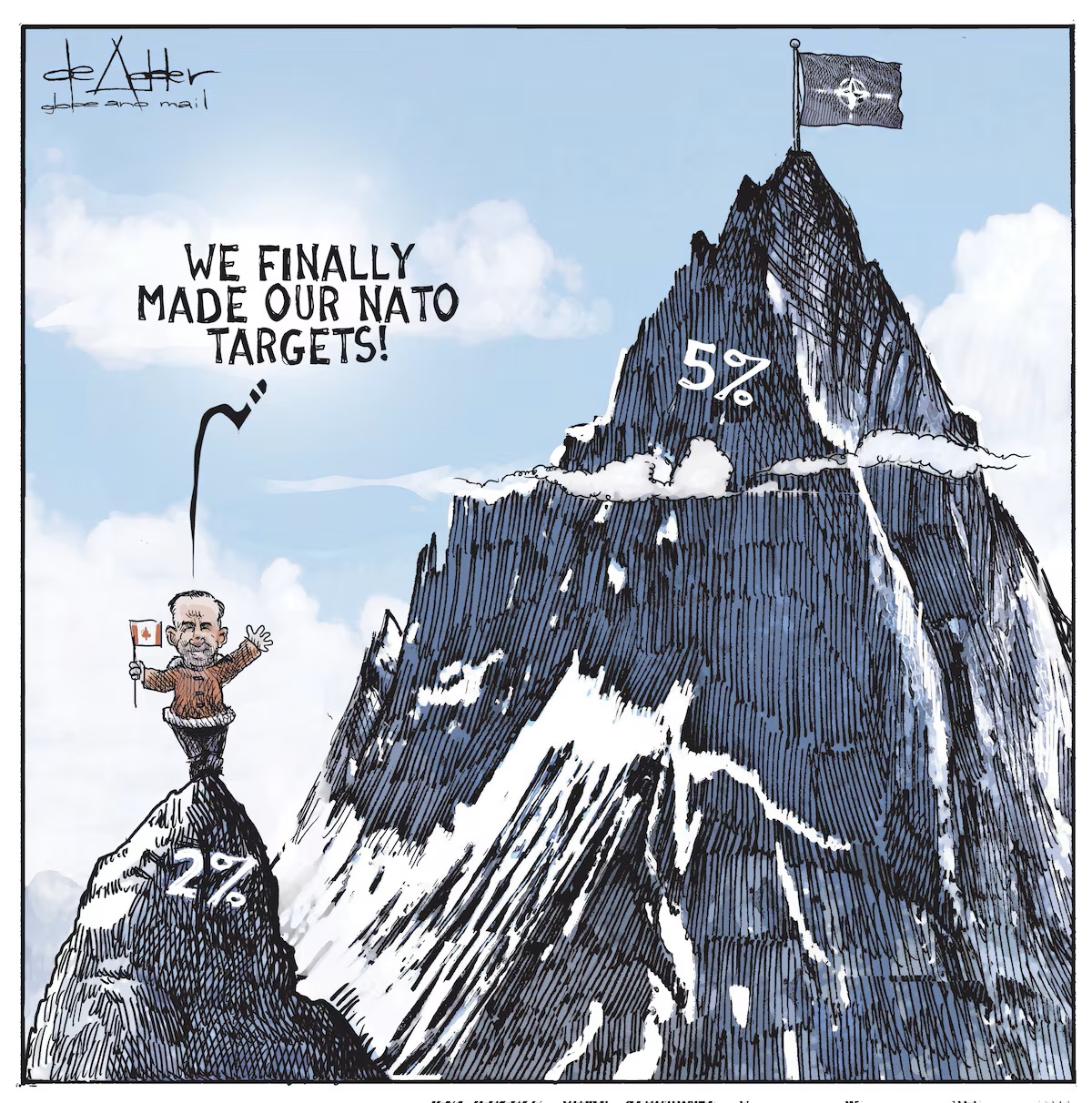
Carney’s defence commitment a welcome first step. But much more is needed as NATO is set to increase minimum GDP requirement from 2% to 5%
Jun 18, 2025 | Editorials, Featured
Marco Levytsky, Editorial Writer
Two weeks ago, we commented that Canada must move much faster towards reaching NATO’s 2% of GDP minimum requirement for defence spending than the 2030 target Prime Minister Mark Carney had set earlier.
June 9 Carney announced that he has moved up the target date from 2030 to the end of this fiscal year, March 31, 2026. This will involve an increase of $9.3 billion for the Department of National Defence on top of its existing budget of just under $40 billion. When added to existing defence-related spending in other departments of around $14 billion, this will push total expenditures to $62.7 billion for 2025-26, which represents 2% of Canada’s GDP, according to the government.
“In an increasingly dangerous and divided world, Canada must be prepared – to defend our people and our values, to secure our sovereignty, and to protect our Allies. We must be prepared to lead and to shape a more stable and prosperous world. This entails government recognizing our new realities and investing in the measures required to meet this moment,” stated a government press release announcing the increase.
Speaking at the University of Toronto’s Munk School, Carney said one of the reasons for the acceleration of the budget increases is to make Canada less reliant on the United States for security and move closer to it European allies.
“We stood shoulder to shoulder with the Americans throughout the Cold War and in the decades that followed, as the United States played a dominant role on the world stage. Today, that dominance is a thing of the past,” he said.
Carney also noted that this planned spending increase is necessary in an increasingly “dangerous and divided world,” where threats are unravelling the rules-based international order.
“Threats which felt far away and remote are now immediate and acute,” Carney said, citing “Russia’s barbaric invasion of Ukraine” and threats to security and sovereignty not only from Moscow but also from “an increasingly assertive China.”
However, this acceleration of hitting the target of two percent of GDP comes just as NATO leaders are set to discuss raising the minimum requirement to 5% of GDP at their upcoming summit in The Hague, June 24-26. This would include a 3.5% allotment to core defense spending and 1.5% for infrastructure and rapid deployment capabilities.
Speaking with reporters on June 9, Carney said his government expects a “further acceleration of spending” but did not provide any specific details.
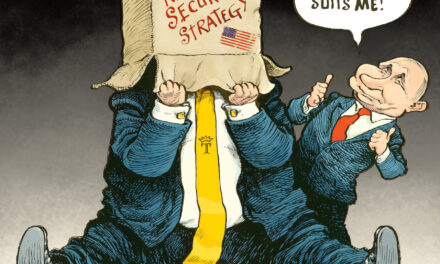
Several countries, including Sweden, the Netherlands, Poland, and the Baltic states, have already committed to this 5% goal. As mentioned in our previous editorial, during World War II Canada increased its defence spending from 1.33% of GDP to 37% in just five years. Therefore, an increase to 5% for Canada is viable. And the need is definitely there. Just as in 1939 the world faced a brutal and aggressive German dictator bent on regaining a lost empire so today it faces a similar threat from a Russian dictator bent on regaining a lost empire. And that is why Vladimir Putin launched Russia’s genocidal war against Ukraine. And just as in 1939 an isolationist America was determined to stay away from the conflict so today an isolated America not only does not want to support Ukraine with armaments but actually pressures the valiant country to capitulate to Moscow’s demands. Were Ukraine to be sacrificed to Moscow — as many of today’s appeasers are quite willing to do – it would only feed Putin’s appetite for more and lead to World War III.
Carney also wants Canada to reduce its purchases of U.S. military goods and join a European Union defence procurement program. “We should no longer send three-quarters of our defence capital spending to America,” he says. One clear step in that direction would be to scale back Ottawa’s order for the F-35s and instead buy European-made fighter planes.
In 2022 the federal government finalized a deal to buy 88 F-35 Lightning fighters from Lockheed Martin at which time the acquisition would cost about $19-billion. But that cost has now jumped 50% to $27.7-billion. So far Canada has committed only to buy 16 planes.
Sweden is promoting the Saab JAS 39 Gripen as an alternative to the F-35 fighter jets, offering affordability, NATO/NORAD compatibility, and full operational sovereignty. What’s more, Saab is offering to create two new aerospace centres in Quebec that will create and protect thousands of aerospace and related jobs. Talks with Swedish manufacturer Saab regarding the Gripen have resumed despite the Canadian contract for F-35A jets.
As a first step, Carney’s June 9 announcement is a welcome one since it demonstrates the government is aware of the urgent need to increase defence spending and is moving in the right direction. But the question remains where the government will find the money. Since it is not releasing the budget until the Fall, we can only speculate at this point in time. Combined with the government’s pledge to cut taxes for the middle class, which is expected to cost about #27 billion over the next five years, the government will either have to raise the already ballooning national debt to even higher levels, or cut services – a measure that will be politically unpopular.
But the government must make the case that the urgency of the crisis facing the world calls for strong measures. And if that means sacrifices, then sacrifices will have to be made. Just think of the people of Ukraine. It was the poorest country in Europe before Russia’s full-scale invasion. Since then, the poverty rate has jumped 400% and the country needs almost US$500 for reconstruction. Yet it still managed to devote 36.5 percent of its GDP in 2023 and 30% in 2024 to defence. In doing so, Ukraine valiantly stood up to Russian expansionism and massively degrade its war machine. But it has done so at an enormous cost – not only in material goods, but also in the most precious commodity of all– human life.
Share on Social Media