Marco Levytsky, Editorial Writer
On February 1, U.S. President Donald Trump signed an executive order imposing across-the-board tariffs of 25% on Canadian goods and 10% tariffs on energy starting February 4. The order was to take effect on most goods at 12:01 a.m. on February 4. He also imposed 25% tariffs on Mexico and 10% on China, and threatened additional tariffs should Canada retaliate.
Even though Canada did manage to get a last-minute reprieve following Prime Minister Justin Trudeau’s second telephone conversation with Trump on February 3, that suspension is only for one month. It is very clear that Trump is playing brinkmanship politics here and a very real threat still remains. What is also clear is that Trump’s justifications for inflicting tariffs on Canada are without foundation.
Trump accuses Canada of playing a “central role” in the movement of narcotics and illegal migrants into the U.S., claiming that the amount of fentanyl that crossed the border from Canada is enough to kill 9.5 million Americans, that 300,000 died last year and that “millions and millions” of illegal aliens have crossed into Canada. Here are the facts.
The number of illegal immigrants crossing from Canada to the U.S. is significantly lower than that crossing from Mexico. Between October 2023 and July 2024, U.S. Customs and Border Protection recorded 19,498 encounters with migrants crossing the northern border. In contrast, the southern border saw over 2 million encounters in 2023. Mexico remains the leading country of origin for most undocumented immigrants in the U.S.
As for the illicit fentanyl trade, there were 72,776 deaths resulting from fentanyl in 2023, according to the National Center for Health Statistics. The amount of fentanyl coming from Canada made up less than 1% of all fentanyl seized nationwide by the U.S. Border Patrol and the Office of Field Operations—in other words, the same as with illegal immigration.
The majority of the illicit fentanyl consumed in the United States is manufactured abroad. The supply chain typically begins in China, where most of fentanyl’s precursor chemicals—the ingredients for the drug—are made. U.S. Customs and Border Protection data show that in Fiscal Year (FY) 2024 there were 21,148 pounds of fentanyl seized by officials at the southwest border—the vast majority of which was intercepted from people, largely American citizens, coming through legal ports of entry. Meanwhile, there were 43 pounds seized from people crossing the northern border in FY 2024—and most of it was captured by Border Patrol, not at legal ports. That was up from just two pounds confiscated in FY 2023 and 14 pounds seized in FY 2022.
The most important commodity the United States imports from Canada (by dollar value) is crude oil, which amounts to approximately 29% of the total. Manufactured goods account for about 65%. However, 76% of total Canadian exports to the U.S. are used as inputs by U.S. businesses in their own production. This is especially true of the automobile industry, whose supply chain is so integrated between the two countries that parts may cross the border seven or eight times before the vehicle is finished. Will tariffs be applied every time a part crosses the U.S. border?
By contrast, manufactured goods account for virtually the total value of all U.S.-bound exports from China, which is a close third behind Canada and Mexico in terms of total trade with the U.S. China, however, is by far the largest trading partner of the U.S. measured by the dollar value of both its exports and trade surplus. In 2023, electrical and electronic equipment was the top category, valued at approximately $124.52 billion, followed by machinery at $88.98 billion. So why, after talking tough on the campaign trail, and threatening China with 60% tariffs, has Trump suddenly cozied-up to President Xi Jinping and dropped this to a relatively modest 10%?
It is clear that Canada is being deliberately targeted for grossly disproportionate treatment. This is a disgraceful way to treat America’s closest ally. It also makes absolutely no economic sense. It is American consumers who will be forced to contend with higher prices despite Trump’s campaign promises to rein in inflation. The impact on both countries’ economies will be quickly felt and decidedly negative.
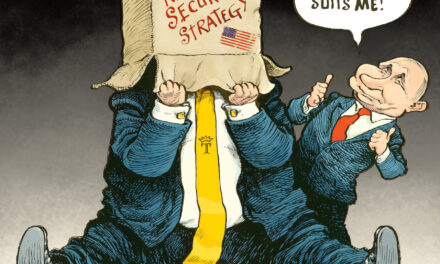
So, what is Trump’s motivation in ordering such a punitive measure? Frankly, no explanation yet provided by the President is remotely compelling. If there is evidence to support any rationale, it is that he actually wants to annex Canada and is using these measures to remind Canadians that their independence comes with some very real costs. In the past, many people dismissed this as a joke, but he has openly admitted to being driven by a vision of Canada someday formally joining the United States of America. On February 2, he claimed the U.S. pays billions to “subsidize” Canada and argued that “without this massive subsidy, Canada ceases to exist as a viable Country.” He went on to say on the Truth Social media platform, “Therefore, Canada should become our Cherished 51st State”.
We cannot allow him to fulfill his imperialist agenda. We must stand up for our freedom, sovereignty and independence. We must fight back. We must provide a united front and the best place to start is to remove all the interprovincial trade barriers that still exist. We must use this one-month reprieve to remove such barriers as quickly as possible and make other changes that will better prepare us to withstand the Trump tariff onslaught whenever it does come.
Trudeau’s initial response to Trump’s February 1 executive order was to announce that Canada will impose 25 per cent tariffs on $155-billion worth of American imports, starting on February 4 with $30 billion in goods and adding $125 billion in goods 21 days later. He also said that Canada is considering “non-tariff measures” that could affect exports to the United States including critical minerals, energy and government procurement, adding that this would be done in consultation with the provinces and that “no one part of the country should be carrying a heavier burden than any other.” That has been put on hold for now.
Opposition Leader Pierre Poilievre condemned Trump’s tariffs as “massive, unjust and unjustified” and suggested “dollar-for-dollar tariffs carefully aimed at maximizing impact on American companies while minimizing impact on Canadian consumers. That means targeting U.S. products that we can make ourselves, buy elsewhere or do without. For example, we must retaliate against American steel and aluminium, as Canadians can make those vital products at home.”
Mark Carney, one of the two front-runners for the Liberal leadership, said “Canada will not bow down to a bully,” adding that Trump’s announcement requires “the most serious trade and economic responses” in the nation's history. Like Poilievre, he advocated for “dollar-for-dollar retaliatory tariffs” to be enforced “where they will be felt the hardest in the United States but will have the least impact in Canada.”
Chrystia Freeland, the other front-runner, was not only more specific, but went even further. “By immediately releasing a targeted list of potential retaliatory tariffs for a seven-day consultation on $200 billion worth of American imports, we can hit Trump where it hurts. By targeting products from Republican states that voted for Trump and products made by his billionaire buddies, Canada can exert unavoidable political pressure on the White House. Canada’s dollar-for-dollar retaliation must be drawn from this list,” she wrote in a January 31 email. In particular, she advocated for a 100 per cent tariff on all Tesla vehicles, which are manufactured by Trump’s multi-billionaire supporter Elon Musk.
Indeed, reversing these mutually destructive measures will likely require U.S. Republicans to gather up the courage to stand up to Trump’s tyrannical governing style, by exercising their constitutional duty to prevent any one branch of government from exceeding its bounds. Section 8 of the U. S. Constitution explicitly states, “Congress shall have (the) Power To lay and collect Taxes, Duties, Imposts and Excises”. Republicans should also look for inspiration to that icon of modern American conservatism, Ronald Reagan. The words he spoke in a radio address to the nation on November 26, 1988, are even more relevant today than they were then:
“Today, protectionism is being used by some American politicians as a cheap form of nationalism, a fig leaf for those unwilling to maintain America's military strength and who lack the resolve to stand up to real enemies—countries that would use violence against us or our allies. Our peaceful trading partners are not our enemies; they are our allies. We should beware of the demagogues who are ready to declare a trade war against our friends—weakening our economy, our national security, and the entire free world—all while cynically waving the American flag. The expansion of the international economy is not a foreign invasion; it is an American triumph, one we worked hard to achieve, and something central to our vision of a peaceful and prosperous world of freedom.”
Share on Social Media