Marco Levytsky, Editorial Writer
On December 12, the European Union indefinitely froze around €210 billion (C$340 billion) of Russian sovereign assets and now is preparing to use them to finance loans for Ukraine. This replaces the previous system of renewing freezes every six months, making the measure open-ended until the EU deems there is no longer a threat to its economic interests.
The European move also marks a major escalation in the EU’s response to Russia’s invasion of Ukraine, with plans to channel proceeds from these immobilized funds to aid in Ukraine’s defense and reconstruction. By doing so, the EU locks-in the assets under its jurisdiction for the foreseeable future and, simultaneously, precludes the United States from dividing between itself and Moscow the monetary value of those assets as one of the terms of a future peace settlement it might yet impose upon Ukraine, with Moscow’s full blessing. The EU’s action helps Ukraine by securing a massive financial lifeline—potentially over €90 billion in loans—while also signaling that Russia will eventually pay reparations for the war.
While most EU governments support the freeze, some countries (like Hungary and Slovakia) oppose it, arguing that the move risks destabilizing Europe’s financial system.
Another country that is expressing caution is Belgium, which holds about €185 billion of the €210 billion in Russian state assets through the Brussels-based clearinghouse Euroclear.
Actually, Belgium supports the freeze itself but is hesitant about repurposing the funds for Ukraine without ironclad legal guarantees and shared EU responsibility for the financial risks involved since Russia has already launched a lawsuit against Euroclear.
In order to override the opposition, the European Commission invoked Article 122 of the Treaty on the Functioning of the European Union (TFEU) which allows the EU to act in situations of crisis on the basis of qualified majority voting instead of unanimous consent.
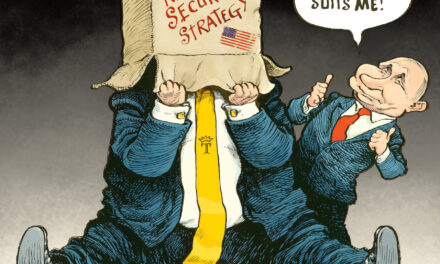
Europe has taken a bold step forward. But it is not nearly enough. When it comes to defending not only Ukraine, but the EU itself, much more is needed. That’s because strong support for democracy and democratic values around the world can no longer be taken as a given. Few things underscore this point more emphatically than the proclamation of U.S. President Donald Trump’s 2025 National Security Strategy.
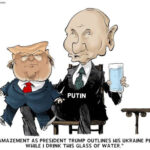
Sadly, Trump’s “new” approach to geopolitics and national security, based on “America First” principles, marks the abandonment of democratic values and an abrupt reversion to transaction-driven foreign policy where “might makes right” and win-win agreements are replaced by outcomes in which the winner-takes-all. As far as Trump is concerned, the entire Western Hemisphere is within the U.S. sphere of influence. The rest of the world can be divided between Russia, China and other despotic states. This strategy portends Europe’s “civilizational erasure,” and in an effort to reverse it urges the U.S. to cultivate resistance movements, namely far-right supporters of Trump and Russian dictator Vladimir Putin, within European societies. As for Russia itself, it seeks pragmatic alignment advocating “flexible realism” and seeks strategic stability. Not surprisingly, the Kremlin welcomed Trump’s new national strategy, saying it aligns with Russia’s worldview—high praise indeed from a former Cold War rival. As for Europe, critics labeled the strategy far-right and destabilizing.
The strategy is an abrupt departure from the post-World War II international order. It rejects multilateralism and cooperative security frameworks opting instead for a return to 19th Century imperialism and colonialism, when European nations and the United States alike established far-flung empires and divided the rest of the world into spheres of influence to be exploited. As far as Trump is concerned, Ukraine is within Russia’s sphere of influence, and the rest of Europe can fend for themselves even if they’re swallowed up by a resurgent Russian Empire.
Meanwhile, Trump has begun imposing his will over the America’s by launching an undeclared war against Venezuela, indiscriminately bombing speed boats that he claims (without evidence) are carrying drugs, even to the point of killing survivors who managed to escape the sinking vessels. This is a war crime. Trump is even threatening to launch a land invasion of the country. No objective observer can dispute the fact that Venezuela’s President Nicolás Maduro is a despot who fixes elections and persecutes the opposition. But that applies to many of Trump’s far-right friends as well. U.S. officials claim Venezuela has enabled hundreds of tonnes of drugs annually to pass through its territory and, ultimately, to enter America, but no court has yet convicted anyone from that country of engaging in large-scale drug smuggling to the U.S. or has had an opportunity to even consider evidence of such alleged criminal activity.
On the other hand, former Honduran President Juan Orlando Hernández was convicted of trafficking over 400 tonnes of cocaine into the United States during his tenure and America sentenced him to 45 years in prison. Trump, however, has pardoned him, proving that whatever he may claim about battling “narco-terrorists” has no foundation in fact. Trump simply wants to install his own puppets in the Western Hemosphere, just as Putin wants to install his puppets in Europe.
Nowhere has the U.S. abandonment of democratic principles in favour of the expansion of despotism been more evident than in the United Nations. The United States has voted with Russia against Ukraine at least three times in 2025 — twice on resolutions directly about the war in Ukraine and, most recently, on a resolution to strengthen cooperation on mitigating the consequences of the Chornobyl nuclear disaster, explicitly referencing Russia’s attacks on the site. Seven other nations joined the U.S. in this unconscionable vote – a virtual rogue’s gathering of brutal dictatorships — Russia, Belarus, China, North Korea, Nicaragua, Niger, and Mali.
***
As we approach the celebration of the Birth of our Lord and Saviour, let us take time to remember and pray for the tens of thousands of Ukrainian children kidnapped by Russia, the thousands of POWs still locked-up in horrific conditions in Russian prisons, the hundreds of thousands of dead and wounded soldiers and civilians alike, and the millions of other victims of the war, many of whom have left Ukraine for safe harbour elsewhere. Let us do our part to support them in their time of need with all manner of humanitarian and medical aid, and to also give generously in support of the Ukrainian World Congress’s efforts to supply Ukraine’s defenders with the resources they need to expel Russia’s armies from Ukrainian lands and to quash, once and for all, Putin’s dream of eliminating from the face of the earth all traces of the Ukrainian nation.
Христoс Раждається! Славiм Йoгo!
Christ is Born! Let us Glorify Him!
Share on Social Media