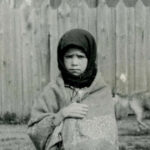
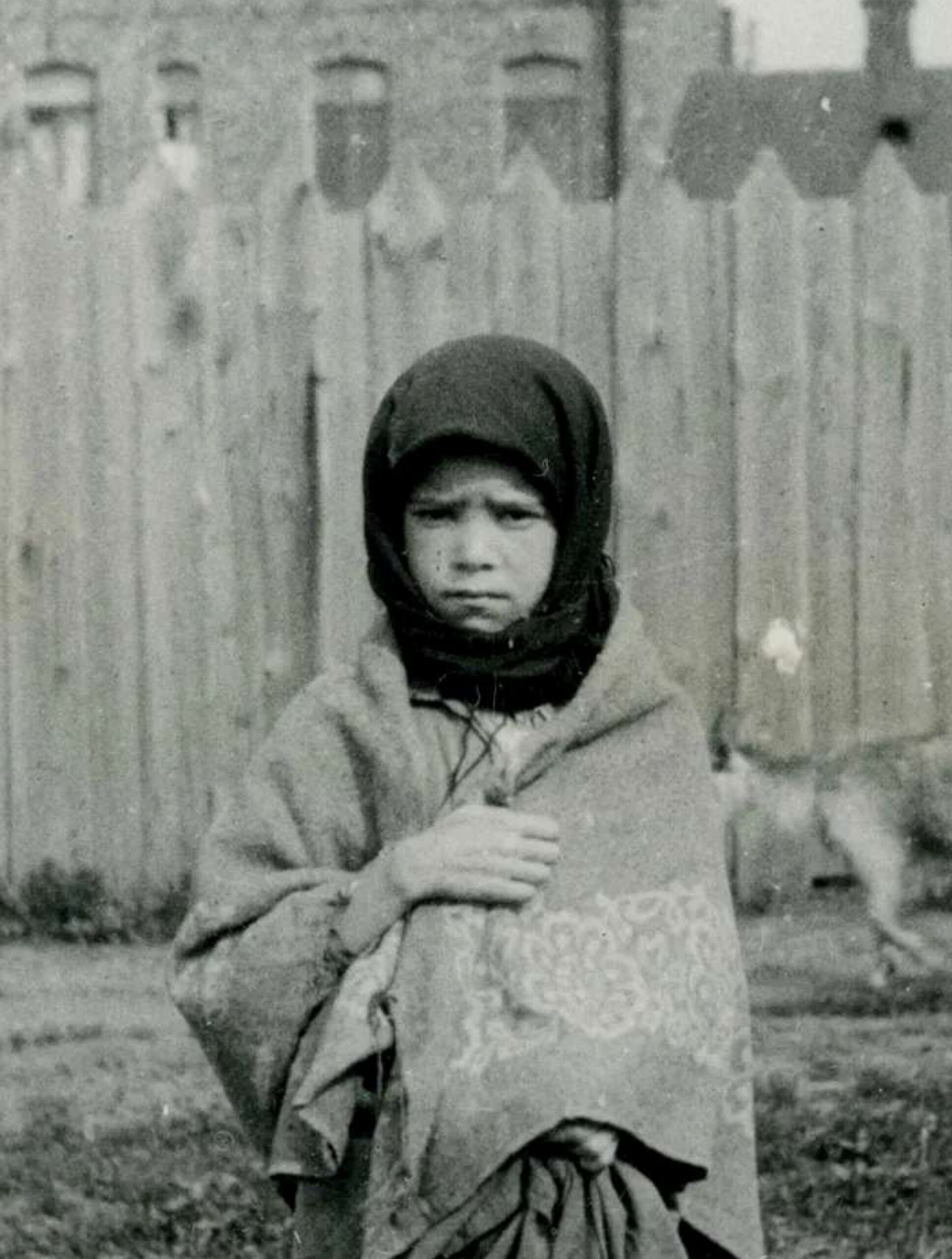
A young child, showing obvious signs of starvation, during the Holodomor, Kharkiv, Ukraine, photo by Alexander Wienerberger, 1933.
As we commemorate the victims of the Holodomor, let us draw attention to the same crimes against humanity being committed today
By Marco Levytsky, Editorial Writer
This coming Saturday, November 22, people around the world will commemorate the genocidal famine now known as the Holodomor (literally “death inflicted by starvation”) that took place in Ukraine over nine decades ago. In 1932 and 1933. millions of Ukrainians were murdered in this man-made famine engineered by the Soviet dictatorship of Joseph Stalin. It started with the August 1932 “Five Stalks of Grain” decree which stated that anyone, even a child, caught taking any produce from a “kolhosp” or collective farm could be shot or imprisoned for stealing “socialist property.” By the beginning of 1933, some 54,645 people were reportedly tried and sentenced for this crime and, of those, 2,000 were executed.
As the famine worsened, growing numbers of farmers left their villages in search of food outside of Ukraine. Directives sent by Soviet dictator Joseph Stalin and his closest collaborator, Vyacheslav Molotov in January of 1933, sealed the borders of Ukraine in order to foreclose the ability of any victims to escape the famine and find food elsewhere.
To further restrict Ukrainian farmers from leaving their villages to seek food in the cities, the Soviet government created a system of internal passports, pursuant to which even internal travel became impossible for farmers without official permission. These same restrictions applied to the Kuban region of Russia, which borders Ukraine, and in which Ukrainians made up the largest portion of the population – 67 percent.
At the height of the Holodomor in June of 1933, Ukrainians were dying at a rate of 28,000 people per day. While Ukrainians were starving to death, the Soviet state extracted 4.27 million tons of grain from Ukraine in 1932, enough to feed at least 12 million people for an entire year. Soviet records show that in January of 1933, there were enough grain reserves in the USSR to feed well over 10 million people. The government could have organized famine relief and could have accepted help from outside of the USSR, but Moscow rejected foreign aid and denounced those who offered it, instead exporting Ukraine’s grain and other foodstuffs abroad for cash.
While it is impossible to determine the precise number of victims of the Ukrainian genocide, most estimates by scholars fall in a range between 3.5 million and 7 million (with some estimates going even higher). Historians agree that, as with other genocides, the precise number will never be known. But what makes estimating the death toll even more difficult in the case of the Holodomor is that the 1937 Soviet census showed such a decline in the population of Ukraine that Stalin declared it to be invalid and had the statisticians who complied it arrested and, in many cases, executed. Two years later a new census was published with falsified figures.
Regardless of the exact number of victims, there is no doubt that the Holodomor was an act of genocide aimed at destroying Ukraine as a nation. This fact was confirmed by Raphael Lemkin, a Polish Jew and legal expert, who first coined the term “genocide”. He was later instrumental in the UN General Assembly’s formal adoption of this term and was the first legal scholar to apply the UN definition to the Holodomor. In 1953, five years after the declaration of the UN Convention on Genocide, and on the occasion of the twentieth anniversary of (what at the time was still called) the Ukrainian Famine, Lemkin addressed a 3,000-strong audience at the Manhattan Center in New York with an allocution entitled “Soviet Genocide in Ukraine.” He described the Famine as a four-pronged attack by the Communist regime against the Ukrainian nation with the intent to destroy: (1) the intelligentsia (“the national brain”); (2) the national churches (“the soul of Ukraine”); (3) the independent peasants (“the repository of the tradition, folklore and music, the national language and literature, the national spirit of Ukraine”); and (4) the cohesion of the Ukrainian people by forced in- and out-migration with the aim of changing the republic’s ethnic composition by reducing the number of ethnic Ukrainians and increasing the number of non-Ukrainians.
The reason we commemorate the Holodomor each year is to bring home the message of “Never Again”. Never again should the people of Ukraine nor any other country be subjected to genocide. And never again should food be used as a weapon and famine inflicted upon innocent people.
But not only is this happening today – such crimes against humanity are becoming more frequent and increasing in intensity. In Ukraine, Stalin’s successor, Vladimir Putin has launched a genocidal war which aims to eliminate the Ukrainian nation from the face of the earth. He has relentlessly bombed civilian targets to terrorize the population into capitulation. Children have been abducted and deported to Russia by the tens of thousands in order to indoctrinate them at “filtration” camps and then put them up for adoption to complete the process of Russifying them, leaving no trace of their original Ukrainian identity.
In addition, Russia has deliberately targeted Ukrainian agricultural infrastructure, disrupting global grain exports. This has driven up food prices worldwide and deepened hunger. Meanwhile, U.S. President Donald Trump has cut off USAID which was the largest provider of foreign assistance globally, supporting food supplies, famine relief, and disease prevention. The United Nations World Food Program has warned that the cancellation of USAID could amount to a “death sentence for millions” facing extreme hunger and starvation.
But the worst famines occur in conflict areas. We have already spoken about Ukraine, but that is not the only case in today’s world. Gaza and Sudan are other examples. Starvation is a morally reprehensible, but a cheap and effective weapon. Restricting food supplies requires few resources but can devastate entire populations. It also has a profound psychological impact: Hunger erodes morale, weakens resistance, and forces communities into dependency.
Thus, from Ukraine to Gaza to Sudan, hunger is being deliberately inflicted, and the consequences are global. More than 120 million people have been displaced by violence or persecution, and 60% of the world’s hungriest live in conflict-affected countries. In these areas, food is often withheld or destroyed to weaken populations. Starvation is increasingly recognized as a war crime under international law, yet enforcement remains weak.
Every year we solemnly remember the millions of victims agonizingly starved to death in the Holodomor, as such horrendous crimes against humanity must never be forgotten. But this obligation comes with another solemn duty, that is, to also categorically condemn these same acts of genocide and man-made famines being inflicted by terrorist states upon innocent human beings today. “Never Again” cannot and must not remain an empty slogan. It must resonate around the world until the day eventually arrives when genocide becomes a horror of the distant past and is no longer being visited upon any nation or any people by any murderous state anywhere on the planet we all share.
Share on Social Media