Please sign the petition that is urging the government to provide such a program
Marco Levytsky, Editorial Writer.
Canada has always prided itself on being a welcoming nation for those fleeing conflict and persecution. Given the scale and duration of the crisis in Ukraine, it is imperative that the government acts swiftly to ensure that displaced Ukrainians have the stability and security needed to rebuild their lives. Implementing a clear and accessible pathway to permanent residency would not only honour Canada’s humanitarian commitments, but also strengthen our communities by allowing these newcomers to fully participate in Canadian society.
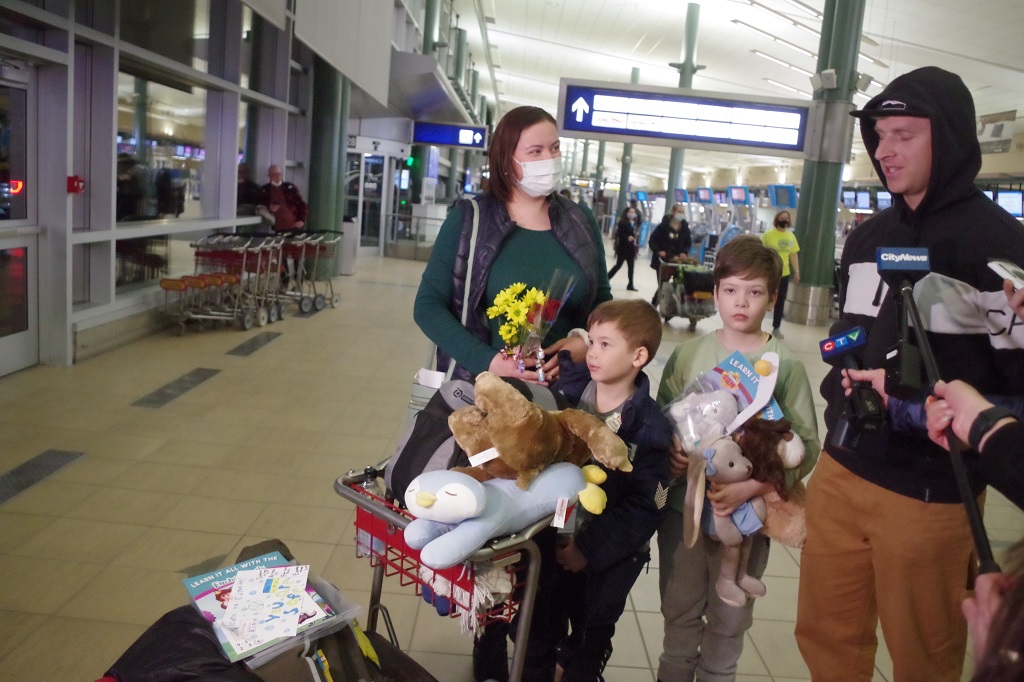
As Russia’s genocidal war against Ukraine continues with no end in sight, Ukrainian nationals who came to Canada under the Canada-Ukraine Authorization for Emergency Travel (CUAET) program are getting very concerned about their future.
With the war in its fourth year, Russian attacks on civilians have intensified. Russian dictator Vladimir Putin has made it very clear he has no intention of stopping and has doubled his attacks on civilians and civilian infrastructure since January 2025. With every month that the war continues, it becomes less likely that Ukrainians will be able to return home or that they will even have a home to return to.
At the same time, having lived in Canada for the last three years, they have found jobs, paid taxes, worked hard, contributed to the development of Canada and established roots in their adopted home. Yet they still have no secure path to permanent residence.
Living on a temporary status means living with hesitation. As one evacuee put it: “Back home, I never had time to buy small things, like a vase. Here, I still don’t — because I don’t know if I’ll be allowed to stay.” That comment captures what so many feel — the inability to plan a future and finally call one place “home”.
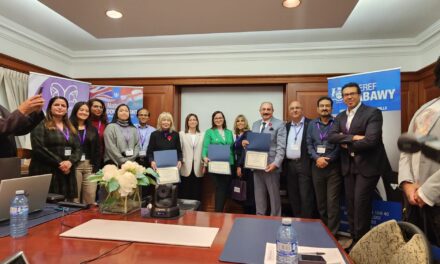
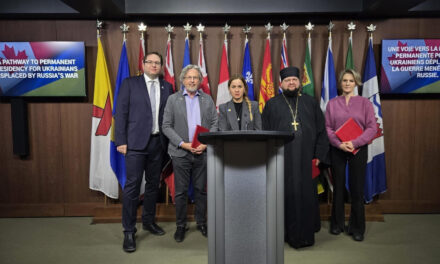
As a result of these concerns the Ukrainian Canadian Congress (UCC) on October 16, called upon the Government of Canada to establish a pathway to Permanent Residence in Canada for CUAET visa holders and their families, and has offered to work with the government to establish such a pathway. In recognition of the important role of provincial governments in Canada’s immigration system, the UCC Provincial Councils will also work with them to increase the number of provincial nominee program allocations.
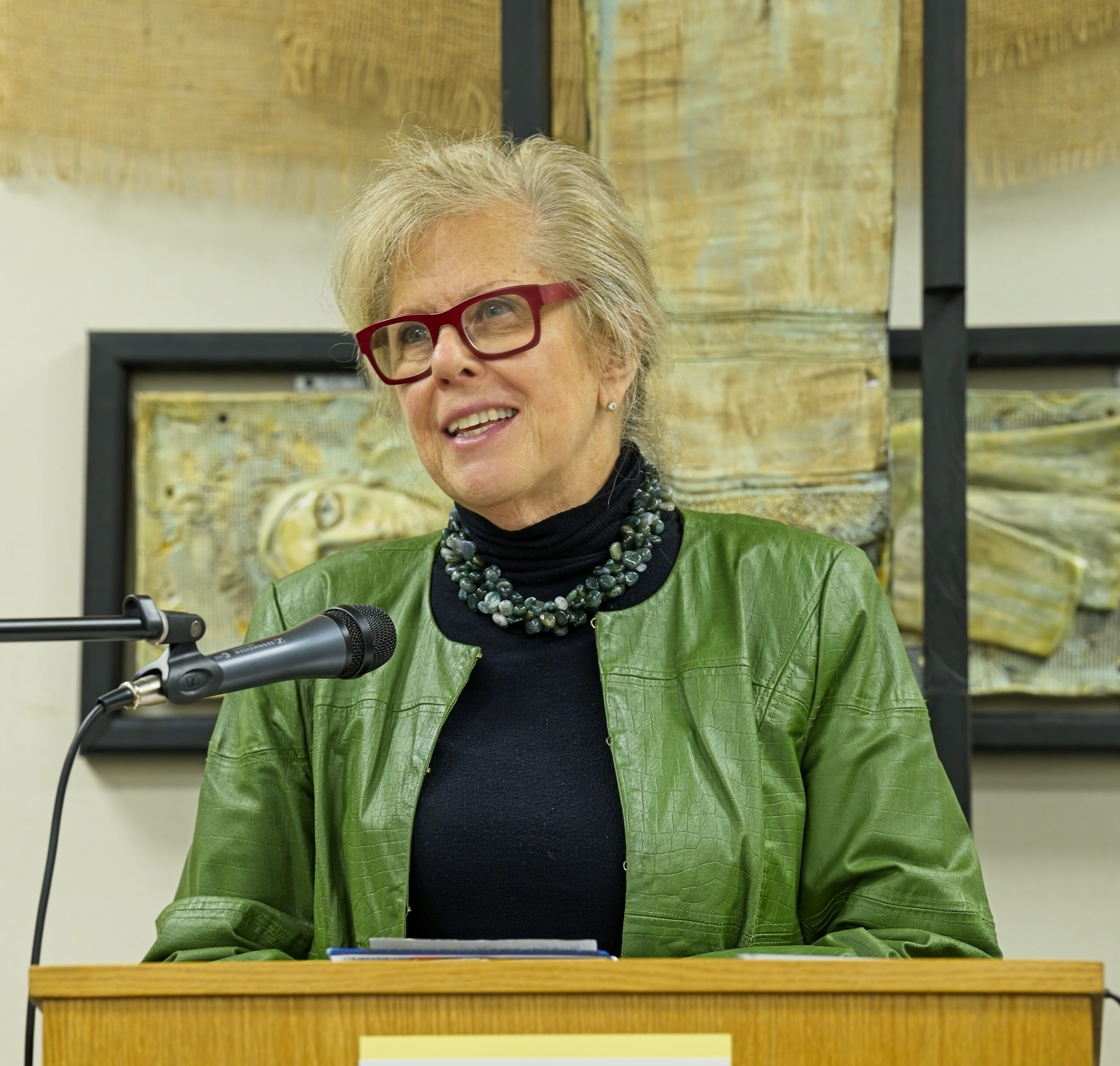
“Many CUAET visa holders report that in addition to not knowing if and when the war in Ukraine will end, the inability to work in Canada uninterrupted and into the foreseeable future, has been a major source of psychological stress and uncertainty for this group,” stated Alexandra Chyczij, UCC National President. “CUAET visa holders risk loss of legal employment as Canadian employers are reluctant to extend longer term employment opportunities to them because of the likelihood that their visa and work permits will expire. Ukrainians displaced by Russia’s war want to support themselves, pay their taxes, and feed their families.”
A recent survey commissioned by the UCC found that 69% of Canadians support more permanent residency pathways for Ukrainians who have been displaced by Russia’s genocidal war. The survey, conducted by Abacus Data, found that “Canadians would ultimately rather welcome than turn away those displaced, with 81% preferring that Ukrainians be able to stay long-term, and 80% agreeing that fuller integration benefits both newcomers and Canadian communities.”
As a result, the UCC recommends that pursuant to the discretion granted to Lena Metlege Diab, Minister of Immigration, Refugees and Citizenship under section 25 of the Immigration and Refugee Protection Act, the Minister approve a Temporary Public Policy (TPP) Pathway for Permanent Residence for Ukrainian citizens who are in Canada under a CUAET visa.
The UCC in its news release set out criteria based on an analogous successful earlier program that was adopted for Hong Kong migrants to Canada following the take over of that city by mainland China. The details of the UCC proposal are:
The qualifying applicants will:
- Hold a valid CUAET visa which provides for temporary resident status in Canada;
- Hold a valid passport issued by Ukraine or can provide evidence that they have submitted an application to renew their passport in Canada but have experienced a delay in obtaining consular services due to the war in Ukraine;
Are physically present in Canada when applying for and receiving permanent residence;
- Demonstrate an intention to live in Canada;
- Achieve a level 4 score in all 4 skills (reading, writing, listening and speaking) in English or French on one of the following scales: Canadian Language Benchmarks (CLB) or Niveau de competence linguistique canadiens (NCLC);
- Have been working legally in Canada for at least 12 months full-time (30 hours per week) or an equal amount of part-time hours (1,560 hours in total) or can provide equivalent proof of income for the 3 years before an application for PR is made.
In anticipation of potential application processing delays, the UCC asks that the Minister permit applicants to apply for an open work permit while waiting for their permanent residence application to be processed, provided that the applicant held a work permit within three years of the government of Canada receiving their permanent residence application.
The UCC further recommends that the Minister reinstate IRCC-funded Language Instruction for Newcomers to Canada (LINC) settlement services for CUAET visa holders for a three-year period.
At the same time, a group of Ukrainian newcomer women in Calgary joined forces to create a petition to the House of Commons, urging the Government of Canada to establish a dedicated, one-time permanent residency pathway for those currently in Canada under CUAET and other temporary emergency immigration measures.
Working with Etobicoke-Centre MP Yvan Baker and his office, they began preparing the text of the petition — carefully crafting it to balance the needs of Ukrainian newcomers with reasonable criteria for such a pathway. With this in mind, the petition encourages the government to consider reasonable eligibility factors such as: legal residence in Canada for at least three of the past four years; Canadian work experience, such as at least one year in a provincially designated critical occupation, or at least two years in other legal employment or self-employment; ongoing economic activity; basic language and education requirements; and at least one indicator of integration.
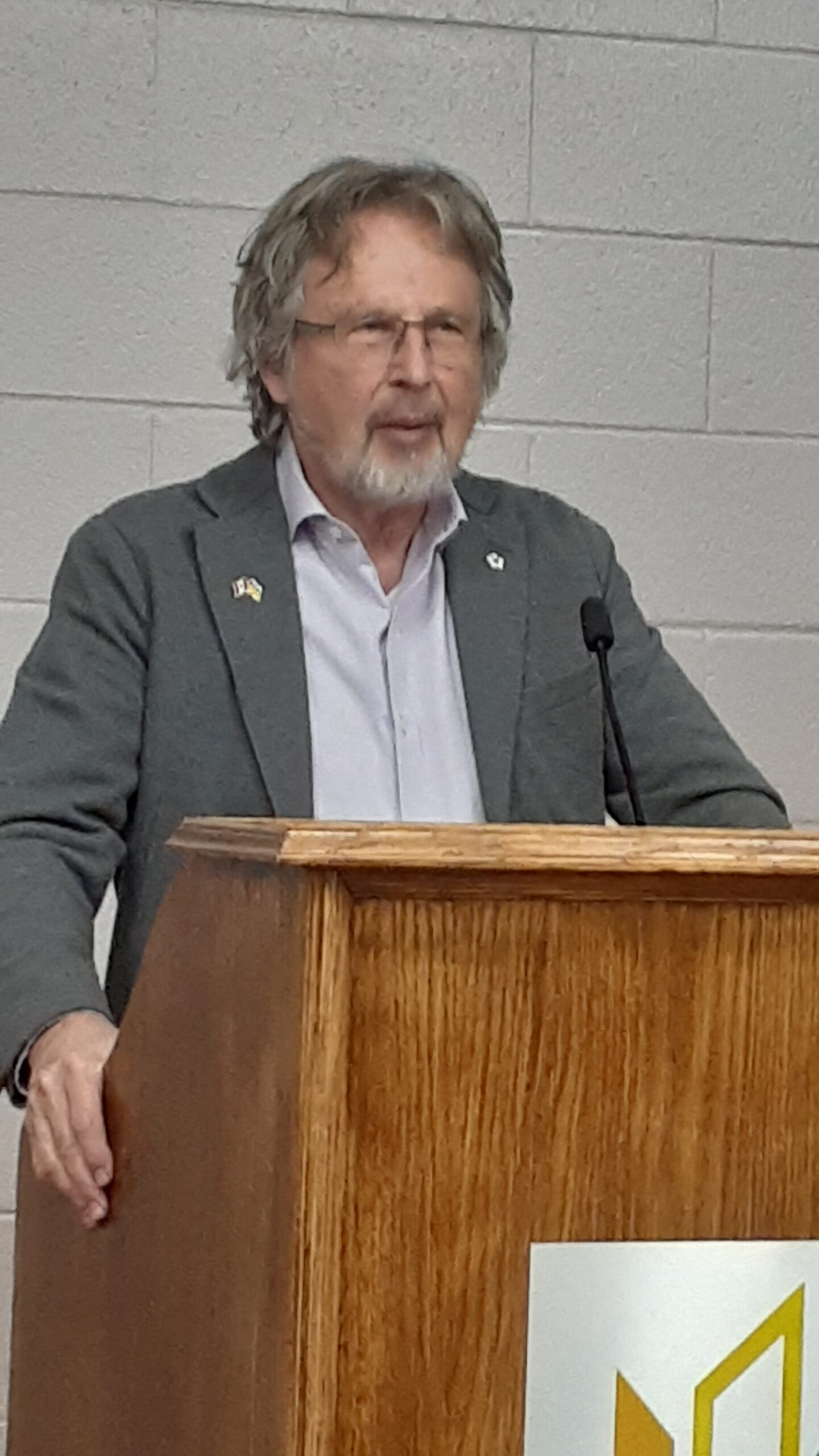
John Stadnyk, a leading figure in the Ukrainian dance community (recent board chair of Calgary’s Tryzub Ukrainian Dance Ensemble) and fierce advocate for Ukrainian newcomers, was invited to officially submit the petition.
The petition went live on October 15, and by the following day over 17,000 signatures had been collected. As this issue went to press on October 21 36,145 signatures had been collected. This is well over the 500 necessary for a petition to be tabled in the House of Commons and the petition will remain online until February 12, 2026. But the petitioner has the right to introduce it whenever it passes the 500-signature point. As the government responds within 45 calendar days (or on the next sitting day if the House of Commons is not sitting) to every petition presented, it may be useful to submit it earlier in order to speed up the process. One way or another, the greater the number of signatories, the more political clout it will have.
Our community should approach this issue from both fronts – support the UCC and its proposal and at the same time get as many signatures as possible on the petition. If you haven’t signed this already, then please sign now and spread this link (https://www.ourcommons.ca/petitions/en/Petition/Details?Petition=e-6866)
as widely as you can to show a broad based support for Ukrainians to gain permanent residence in Canada, the community should support the UCC criteria presented to the government as outlined in their news release. While of course it would be great if every single Ukrainian migrant to Canada could gain permanent residence, there are serious and important impediments in the way to such an effort. Politics has sometimes been defined as the art of the possible, and the UCC has drawn up what our leaders consider as the best approach to take in this case. We therefore endorse that approach now as our best chance to gain support for our people in Canada.
One further area our community should pay attention to is the plight of young Ukrainians who ae graduating from high schools and trying to enter into universities, In some provinces, such students have been designated local residents and therefore eligible to enroll in universities while paying tuition fees equivalent to local students. In other provinces, notably Ontario, they are required to pay international student rates which are out of reach for most of such students. It will be important for our community to gain the support of provincial governments to help these students, and also to lobby for provincial support of the UCC proposal. The same will be true for our community to lobby provincial governments to adopt Ukrainian-friendly immigration policies to enable more Ukrainians to land in Canada as permanent residents under the provincial programs.
As well as benefitting Canada as a whole by creating a path towards permanent residency to a group of highly educated and skilled people who have much to offer, this is a matter of great humanitarian concern. Everyone who empathizes with the plight of these individuals who have left their homeland due to a genocidal war being perpetrated against them should sign. This is especially important for members of our community. As Stadnyk explained: “We must embrace Ukrainians that are already here, part of our communities, our friends, our neighbours, and coworkers. As a diaspora community, we have a duty to support these families.”
Share on Social Media