Marco Levytsky, Editorial Writer
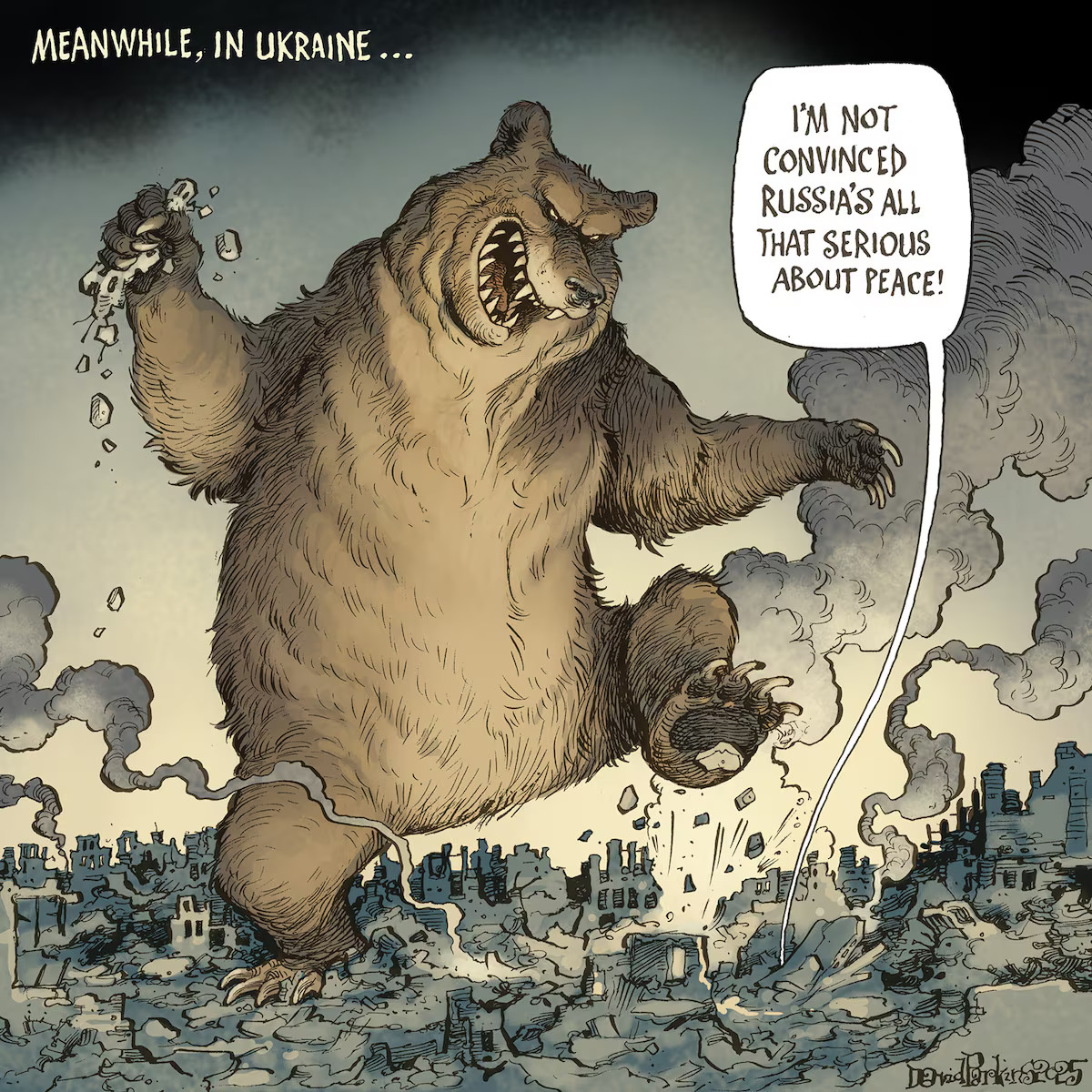
The headline in the August 28 edition of the Kyiv Independent very aptly sums up the status of the so-called peace negotiations initiated by U.S. President Donald Trump. “'Moscow's true answer to peace efforts' — Russian mass attack on Kyiv kills 25, including children,” it read.
Of those 25 people killed, four were children. Sixty-three people, including 11 children, were injured.
Air raid sirens sounded across Ukraine, and residents of nearly every region were urged to seek shelter as Russia launched hypersonic missiles and multiple waves of drones throughout the night. At least four MiG-31 aircraft — jets armed with Kinzhal missiles — took off during the attack.
Russia launched 598 drones overnight, including Shahed attack drones and decoys, as well as 31 missiles, among them two Kh-47 Kinzhal ballistic missiles, nine Iskander-M or North Korean KN-23 ballistic missiles, and 20 Kh-101 cruise missiles, reported the Kyiv Independent citing Ukraine’s Air Force.
Ukrainian President Volodymyr Zelenskyy described the strikes as a “horrific and deliberate killing of civilians” and a clear rejection of diplomacy. He called for new, tough sanctions and urged countries like China and Hungary to take a principled stand against Russia’s war against Ukraine.
“Russia chooses ballistics instead of the negotiating table,” Zelenskyy wrote in his message on X. “It chooses to continue killing instead of ending the war. And this means that Russia still does not fear the consequences.”
European leaders expressed outrage, with European Commission President Ursula von der Leyen calling the attack “another grim reminder of what is at stake.”
All Trump could come up with was that he was “not happy” but “not surprised” and that both Putin and Zelenskyy must want the war to end as well.
On the other hand, Canadian Prime Minister Mark Carney and Foreign Affairs Minister Anita Anand both weighed in on X, posting that Canada stands with Ukraine.
“Last night, Russia launched another brutal attack on Kyiv that deliberately targeted civilians and killed more than a dozen people, including children,” Carney wrote.
“By murdering when he should be talking, Putin demonstrates in the most horrific manner that his mission to subsume the Ukrainian people under his tyranny continues.”
Four days earlier he paid a surprise visit to Kyiv to help Ukraine celebrate its 34th Anniversary of Independence and show Canada’s support.
In his speech, Carney revealed new details about the $2 billion in Canadian funding he previously announced during the G7 Summit in Kananaskis. The money will fund the immediate start of advanced drone manufacturing in Canada and Ukraine, as well as emergency medical and shelter assistance and support for countering digital attacks.
Carney also stated he would not rule out the possibility of Canadian troops playing some role in guaranteeing Ukraine’s security against Russian aggression in the event of a peace deal.
“We are working through with our allies and the coalition of the willing, and with Ukraine, the modalities of those security guarantees on land, in the air and the sea, and I would not exclude the presence of troops,” Carney said, referring to efforts by European countries, including Britain, France and Germany.
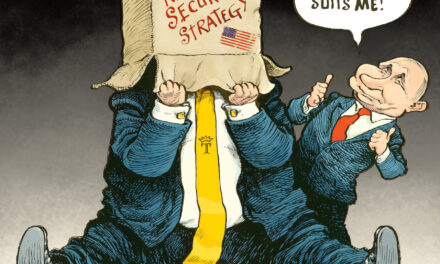
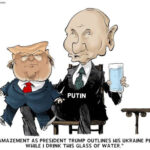
Carney’s willingness to put Canadian troops on the ground if a peace deal is agreed upon is commendable, but it all depends on a peace deal, which, at present, is highly unlikely. With his terrorist attacks on Ukrainian civilians, Putin has made it very clear it is not peace that he wants but, rather, the total destruction of Ukraine as a nation. And he knows he can pursue this goal for as long as it takes, while pretending to seek peace, because he can play Trump like a violin. Trump’s shameless fawning over, and obsequious submission to, Putin knows virtually no bounds.
Consider the following. As the entire world observed, Trump literally laid out a red carpet for Putin in Alaska, and granted Putin – up until then an international pariah — instant legitimacy as a major head of state despite his being wanted on outstanding ICC warrants for arrest on war crimes charges, including the kidnapping of tens of thousands of Ukrainian children. Trump stubbornly refuses to publicly acknowledge that it was Putin who gave the order to invade Ukraine, much less to condemn him for it. Indeed, when pressed, or simply annoyed, Trump invariably blames Zelenskyy for starting the war and for refusing to capitulate to Russia’s much larger and more powerful military. He endlessly threatens to impose devastating economic sanctions on Russia if it does not seriously pursue peace, but has yet to deliver on a single such warning. He blames Biden for prolonging the war by denying Ukraine the ability to launch U.S. missiles deep into Russian territory but has imposed the very same debilitating restrictions upon Ukraine himself. He has cut off all supplies of U.S. weaponry to Ukraine except for purchases made on Ukraine’s behalf by its European allies. After having insisted for several months that a precondition to peace talks to end the war was that Putin first agree to a 30-day ceasefire, Trump inexplicably reversed course after spending just a few hours in talks with Putin. Coming out of their Alaska Summit, Trump – almost as if under a hypnotic spell – suddenly adopted Putin’s proposal that all “root causes” of the war must first be resolved before any serious peace negotiations can begin. And, most egregiously of all, Trump has all but conceded that the U.S. will acquiesce to most, if not all, of Russia’s territorial demands with respect to Ukrainian lands it has captured to date (as well as some lands still entirely under Ukraine’s control) including all of Donbas, as well as all currently occupied parts of Zaporizhzhia and Kherson oblasts.
In other words, Trump has made it very clear that he is not seeking a fair or just peace. To the contrary, he has but one overriding interest in this matter: to dramatically increase his chances of being awarded a Nobel Peace Prize, an international accolade he desperately covets. And, from Trump’s perspective, how might that best be accomplished? Apparently, based on his words and actions to date, by simply granting Putin virtually all that he seeks, forcing Ukraine to accept whatever it can get, declaring the war to be over, claiming credit for the outcome, and being done with it. Beyond that, Trump cares not a whit about the terms of any peace agreement he might persuade or induce the parties to sign using all the political, economic and military leverage he possesses.
Is it any wonder, therefore, that in the face of such servility and toadying up to Putin by Trump, Portuguese President Marcelo Rebelo de Sousa labelled Trump a Russian asset in an August 27 speech? Or that with each passing week, Putin continues to brazenly defy (if not openly mock) Trump and his hopelessly incompetent team of negotiators by further escalating the indiscriminate bombing of civilian infrastructure and the wanton slaughter of innocent civilians. In fact, since Trump was inaugurated, Russian drone and missile strikes on Ukrainian cities have doubled; surely, proof in itself, of the absence of any intention on Putin’s part to seek a peaceful resolution of the war he started.
Ukraine, meanwhile, continues to frustrate the plans of both Putin and Trump. Instead of capitulating, Ukraine is systematically dismantling Russia’s ability to wage war by relying on its domestically designed and manufactured missiles and long-range drones to destroy vital Russian oil refineries, oil storage facilities, gas and oil transmission pipelines and related facilities and pumping stations, anti-aircraft and anti-missile defense systems, missile launching ships, drone factories, ammunition storage facilities, military airfields, strategic bombers, and trains delivering essential supplies including armaments, ammunition and fuel to Russia’s armies stretched across the whole of eastern and southern Ukraine.
Russian military casualties have passed the one million mark and Fortune Magazine says Russia is teetering on the brink of a recession and headed for a disastrous harvest, while Putin’s other top source of cash, sales of oil and gas, plunge.
As Carney put it: ”Putin can be stopped. Russia’s economy is weakening. He is becoming more isolated, and our alliance is hardening. It’s growing more effective, more determined, more united.”
If the U.S. has abandoned its long-held mission to defend democracy around the world, then Canada, the EU, the UK and allies must significantly increase sanctions pressure on Russia, including designating Russia a terrorist state. Canada and our allies must also increase the delivery of air defences and weapons to Ukraine so that Ukraine can better defend its people and cities against Russian terror bombing until Putin is forced to admit the war is lost and withdraw from Ukraine. What happens then is up to the Russians who have supported him but will then need to decide what is best for their country under failing conditions.
Share on Social Media