Marco Levytsky, Editorial Writer.
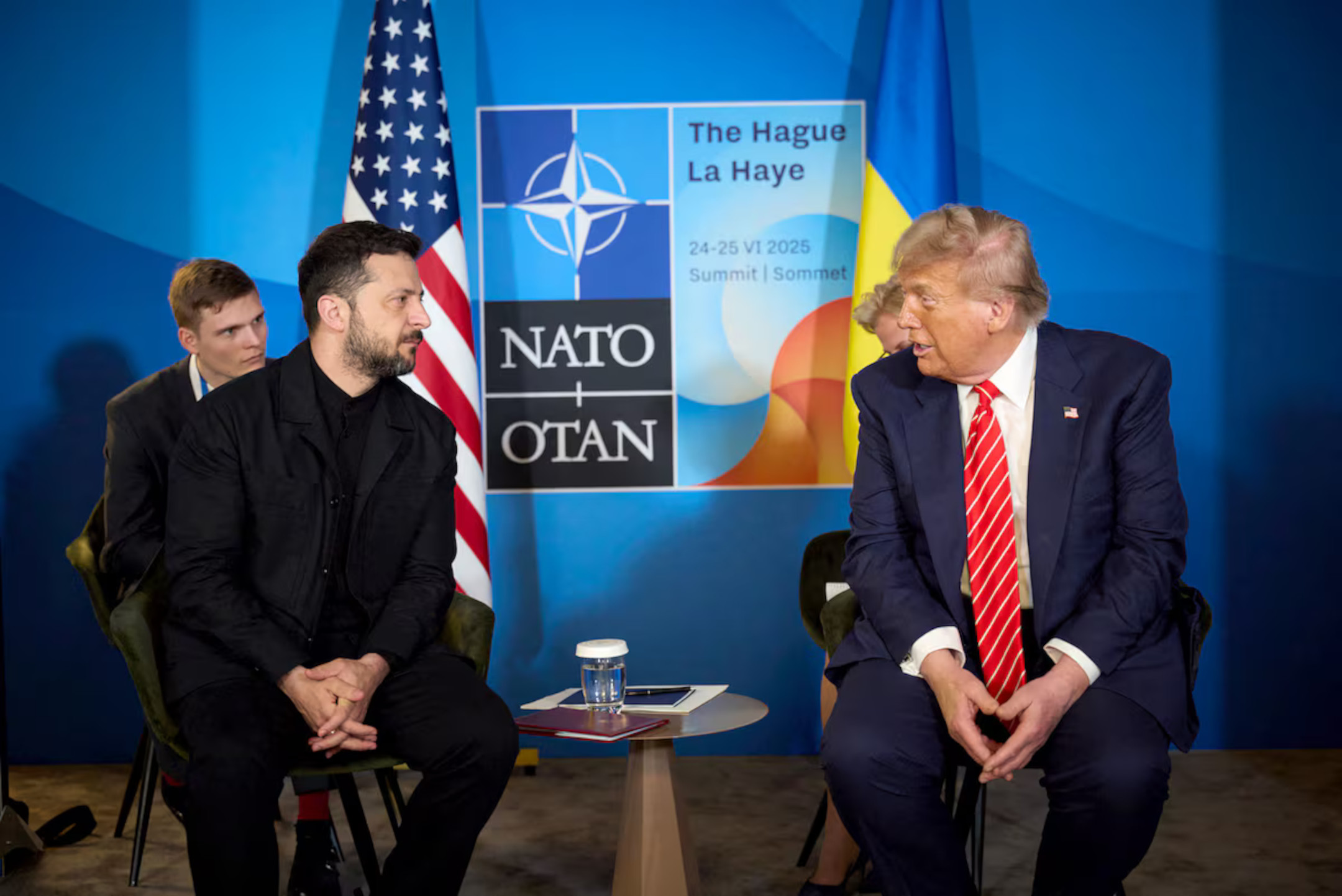
Ukraine’s President Volodymyr Zelenskyy once again used his diplomatic skills to massage U.S. President Donald Trump’s ego at the sidelines of the 2025 NATO leaders summit held in The Hague, Netherlands, June 24-25. On the surface, the 50-minute meeting was very cordial.
Determined to avoid the public humiliation he had to endure during the infamous Oval Office ambush of February 28, Zelenskyy dressed in a black suit rather than his usual army fatigues. Trump described it as very positive, saying Zelenskyy “couldn’t have been nicer”. He emphasized that both leaders shared a desire to end the war in Ukraine, stating, “I think what I took from the meeting… is that he’d like to see it end. I think it’s a great time to end it.”
Trump was in a jovial mood at this conference because NATO Secretary General Mark Rutte praised him for his decision to order airstrikes on Iranian nuclear sites, calling these actions “truly extraordinary” and crediting him with taking decisive steps that “no one else dared to do.” In addition, NATO leaders agreed to devote 5% of their GDP to defence within 10 years, a benchmark Trump had insisted on and hailed it as a personal triumph, saying NATO was no longer a rip-off.
“It’s a monumental win for the United States because we were carrying much more than our fair share. It was quite unfair, actually. But this is a big win for Europe and for Western civilization.”
Zelenskyy, for his part, called the meeting “long and substantive” and thanked Trump for the support, noting they discussed achieving a ceasefire, protecting civilians, and strengthening defence cooperation. He also informed Trump about the situation on the frontline and the increasing number of massive Russian strikes targeting civilians and civilian infrastructure. That information may have opened Trump’s eyes somewhat and led to one of the most talked about moments from his press conference.
After berating the U.S. media for questioning the extent of damage caused by his June 21 bombing of Iran’s nuclear facilities, he responded with uncharacteristic empathy to BBC Ukraine journalist Myroslava Petsa, who asked about supplying air defence Patriot missiles to Ukraine. He proceeded to inquire about the woman’s family, their residence, and her husband who was fighting on the frontlines while she and their children are in Warsaw. Trump acknowledged the difficulty of her situation, saying, “Wow. That’s rough stuff, right? That’s tough,” and added, “I can see that it’s very upsetting to you. Say hello to your husband. Okay? I wish you a lot of luck.”
As for her question itself, Trump stated: “So let me just tell you, they do want to have the anti-missile missiles, as they call them, the Patriots, and we’re going to see if we can make some available. They’re very hard to get. We need them, to we were supplying them to Israel, and they’re very effective.”
The moment sparked widespread discussion online, with some praising Trump’s empathy and others questioning the sincerity of his response. But if Trump was truly empathetic to Petsa’s plight, then “we’re going to see if we can make some available” is simply not good enough. Russia is continuing to relentlessly terrorize Ukrainian civilians with ongoing missile and drone attacks. On June 29 Russia launched its largest aerial assault on Ukraine since the start of the full-scale war, firing 537 aerial weapons — including 477 drones and 60 missiles — across multiple regions. The attack caused widespread destruction and civilian casualties. Trump is absolutely right about the effectiveness of Patriot missiles in air defence and saving lives, which is precisely why Ukraine needs them and needs them now.
But aside from that vague promise to see what the U.S. could do in terms of air defence, he had nothing more substantive to offer Ukraine. When pressed about broader military aid, he responded, “We’ll see what happens,” reflecting ongoing divisions within his party over continued support for Kyiv.
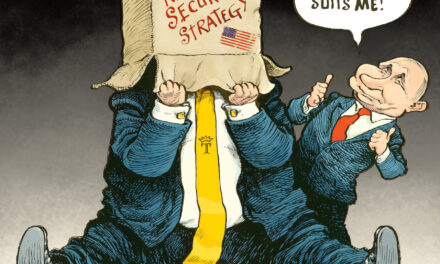
While taking a more conciliatory tone towards Zelenskyy, Trump stubbornly maintained his subservient approach to Russian dictator Vladmir Putin. He would admit only that it was “possible” Putin harbours ambitions beyond Ukraine, but that, battered by manpower and materiel losses, “he’d like to get out of this thing. It’s a mess for him,” As for the continued bombing of Ukraine, the best he could offer was that Putin was “misguided.”
Similarly, there was no indication Trump favoured increased sanctions on Russia. This point was made clear by his loyal Secretary of State, Marco Rubio. In an exclusive interview with Politico’s Dasha Burns on June 25, he stated the administration is holding off from further sanctions on Russia. “If we did what everybody here wants us to do, and that is come in and crush them with more sanctions, we probably lose our ability to talk to them about the ceasefire and then who’s talking to them?” Rubio said.
Meanwhile, the U.S. Senate has delayed its Russia sanctions bill, which would impose 500% tariffs on imported goods from countries that buy Russian oil, gas, uranium and other products, despite the fact that it was supported by 81 out of 100 senators.
And to appease Trump, NATO leaders only approved a brief communique which offered only vague reassurances to Ukraine, lacking any strong commitments and contained no mention of future NATO membership for Ukraine.
The one positive result of the summit was the decision to increase each member’s spending on defence to 5% of GDP, though with a 10-year period in which to accomplish this. This is a step that should have been taken long ago. For too long, other NATO members had been willing to rely on the United States for defence. They were caught off guard when Trump decided to abandon the long-term U.S. policy of defending the existing post-World War II international order in favour of neo-isolationism. And Russia’s brutal expansionism has brought home the very direct threat this poses not only to Ukraine, but also to Europe and the rest of the democratic world. It has become abundantly clear that whatever other NATO leaders may wish for, the United States cannot be counted on as long as Trump is in power. And while 10 years to reach the target of 5% may seem challenging to some, keep in mind that Ukraine was the poorest country in Europe before Russia’s full-scale invasion. Since then, the poverty rate has jumped 400% and the country needs almost US$500 billion for reconstruction. Yet it still managed to devote 36.5 percent of its GDP in 2023 and 30% in 2024 to defence. The rest of the democratic world must take the bull by the horns and be prepared to move much faster than the 10-year deadline if we are to avoid a world war caused by Russia’s unrestricted expansionism.
Share on Social Media