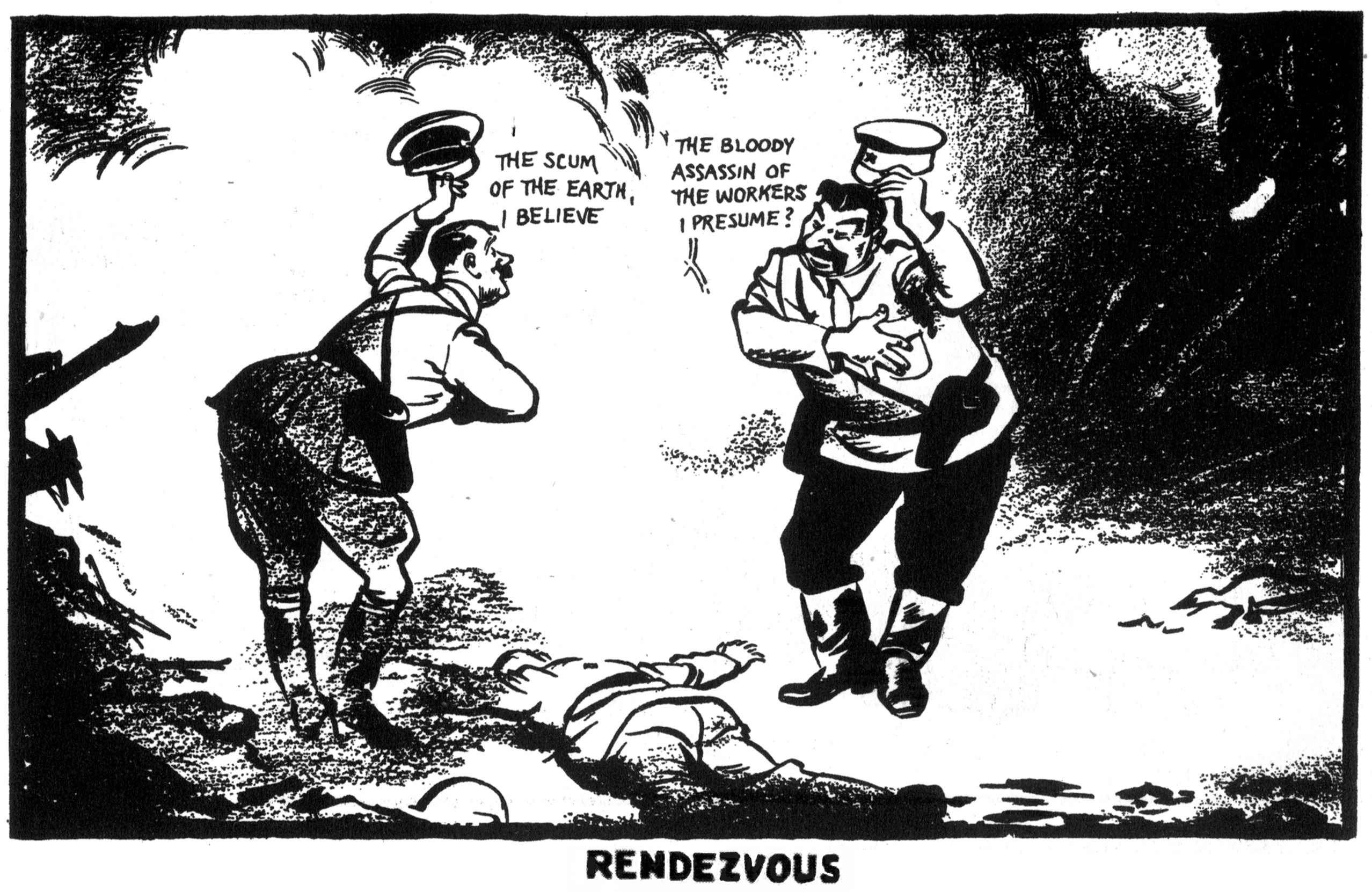
“Rendezvous”, a September 20, 1939, cartoon by David Low in the British newspaper, Evening Standard, satirizing the Hitler-Stalin Pact, which led to the invasions of then Poland from both sides and the start of World War II.
Marco Levytsky, Editorial Writer.
On May 8th, the democratic world celebrated the 80th anniversary of V-E (Victory in Europe) Day. This was especially important for Canadians because Canada's contribution to World War II was immense, even though it doesn’t always receive the recognition it deserves. Canadian soldiers, sailors, and airmen played a vital role in the Battle of the Atlantic and the air war over Germany. The bravery and resilience of the Canadian Army from D-Day to the Liberation of the Netherlands were significant to the Allied victory. In the Netherlands, Canadians saved countless Dutch lives by quickly bringing in food supplies and stayed for months afterward until the population could stand on its own.
The commemoration of that anniversary led to some of the most poignant moments in the many events held as 22 Canadian veterans, ranging in age from 96 to 105, made the long transatlantic trip to participate in the ceremonies. They were mostly pushed in wheelchairs and treated like celebrities, with onlookers reaching out to shake their hands and say thank you. “I'm a very ordinary person who has lived through many extraordinary events, but only by the grace of God. And I'm humbled by this,” 102-year-old George Brewster told CBC News.
Just as Canadians in general don’t receive the same recognition for their contributions that they deserve, the same applies to Ukrainian Canadians. Over 40,000 Canadians of Ukrainian descent served in the Canadian military, making them the second-largest ethnic group in the armed forces. They participated in key operations in Europe and Asia. Their leadership was highly appreciated by various figures and researchers. On May 8th, 2025, a memorial stained-glass window was officially unveiled in London, England, to commemorate the sacrifices of Ukrainian Canadians in the Second World War. This event was organized by the Ukrainian Canadian Civil Liberties Foundation (UCCLF).
But what marred the victory anniversary in some other countries were the acts of some world leaders who usurped this milestone to promote their own political agendas. One such leader was US President Donald Trump. He decided to rename V-E Day to Victory Day for World War II to remove any mention of Europe and to downplay the role of European forces played in defeating Nazi Germany. As he wrote online: “We won both wars. Nobody was close to us in terms of strength, bravery, or military brilliance, but we never celebrate anything. That's because we don't have leaders anymore, that know how to do so.”
While it is true that the entry of the United States proved pivotal in turning the tide of the war and achieving ultimate victory, such comments ignore the immense sacrifices endured by European nations. It also overlooks the fact that in the darkest days of 1940, Great Britain and its Empire stood alone against the Nazi advance. A notable omission from his comments is one he frequently makes, namely – “that would never have happened had I been president.” Yes, in that theoretical world, had Trump been president, the United States would never have entered the war; instead, it would have attempted to pressure Britain to capitulate. This is evident both in his attitude today towards Russia’s genocidal war against Ukraine and in the isolationism and even sympathy for Nazi Germany that characterized both the Republican Party of the day before World War II and the America First movement, both of whose ideologies Trump has enthusiastically embraced.
When the Democrats proposed the lend-lease bill to provide military aid to Britain, opposition was strongest among isolationist Republicans. In the House of Representatives on February 8, 1941, Democrats voted 236 to 25 in favor, while Republicans voted 24 in favor and 135 against. The vote in the Senate on March 8 revealed a similar partisan divide. Isn’t that pre-World War II attitude the same as the attitude of MAGA Republicans towards Ukraine today? When President Franklin D. Roosevelt declared war on Japan following the sneak attack on Pearl Harbor, there was still doubt about whether Republicans would support a similar declaration of war against Germany. Fortunately, Hitler rendered that question irrelevant when he chose to declare war on the U.S. himself.
Would Japan have even attacked Pearl Harbor had Trump theoretically been president? As we noted in an earlier editorial, judging from his comments that Ukraine was responsible for Russia’s full-scale invasion, he would have “made a deal.” All Japan wanted was for the U.S. to end its sanctions against them, cease aiding China in the Second Sino-Japanese War, and allow Japan to access the resources of the Dutch East Indies. Had Trump theoretically been president at that time, he probably would have agreed. After all, aid to China costs money, sanctions against Japan would be bad for business, and he could have easily made a deal to split the resources of the Dutch East Indies with Japan.
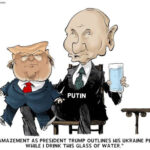
Another leader who uses victory as a propaganda tool to bolster his own political agenda is Russian dictator Vladimir Putin. He tries to portray the victory, which the Russians celebrate a day later than everyone else—based on the excuse that when the official German surrender was formalized in Berlin on May 8, it was already May 9 in Moscow—as a purely Russian effort. In fact, the Red Army was composed of numerous nationalities captivated by the USSR, who served in greater numbers than the Russians themselves. This includes 7 million Ukrainians who made important contributions not only in battles in Ukraine but also in Russia—the surrender of General Paulus’ 6th Army at Stalingrad was accepted by a Ukrainian general.
But the most brazen example of Russia’s historical revisionism is the omission of the Nazi-Soviet non-aggression pact from its historical narrative. According to the Russians, the “Great Patriotic War,” as they call it, began when Hitler invaded the USSR on June 22, 1941, not September 1, 1939, when he invaded Poland. That’s because the invasion of Poland was the immediate result of the Molotov-Ribbentrop Pact signed just one week earlier. Included in that document was a secret protocol under which both Nazi Germany and Soviet Russia agreed to divide what was Polish territory between themselves. Sixteen days after Hitler invaded Poland in 1939, Stalin invaded Western Ukraine and Belarus, which until then had been under Polish rule, initiating a horrendous reign of terror on the civilian population. He followed this up with the forcible annexation of the Baltic states and an attempt to do the same with Finland, which, with courageous resistance, managed to limit his territorial gains.
While we must recognize and pay tribute to the immense sacrifices made by what has been referred to in history as the “greatest generation” for saving the world from extreme evil, we must also learn from history and ensure that such a conflagration is never repeated. That is why the democratic world’s response to Russia’s genocidal war against Ukraine is so important. Putin’s imperialist aims today echo Hitler’s imperialist aims from almost a century ago. Appeasement didn’t work then, and it won’t work today. Republican isolationism in the 1930s failed to prevent the United States from standing up for the international world order because the Democrats controlled both the Presidency and Congress. Today, the situation is reversed, and Trump’s neo-isolationism can have very serious and unfortunate consequences for global security.
Share on Social Media