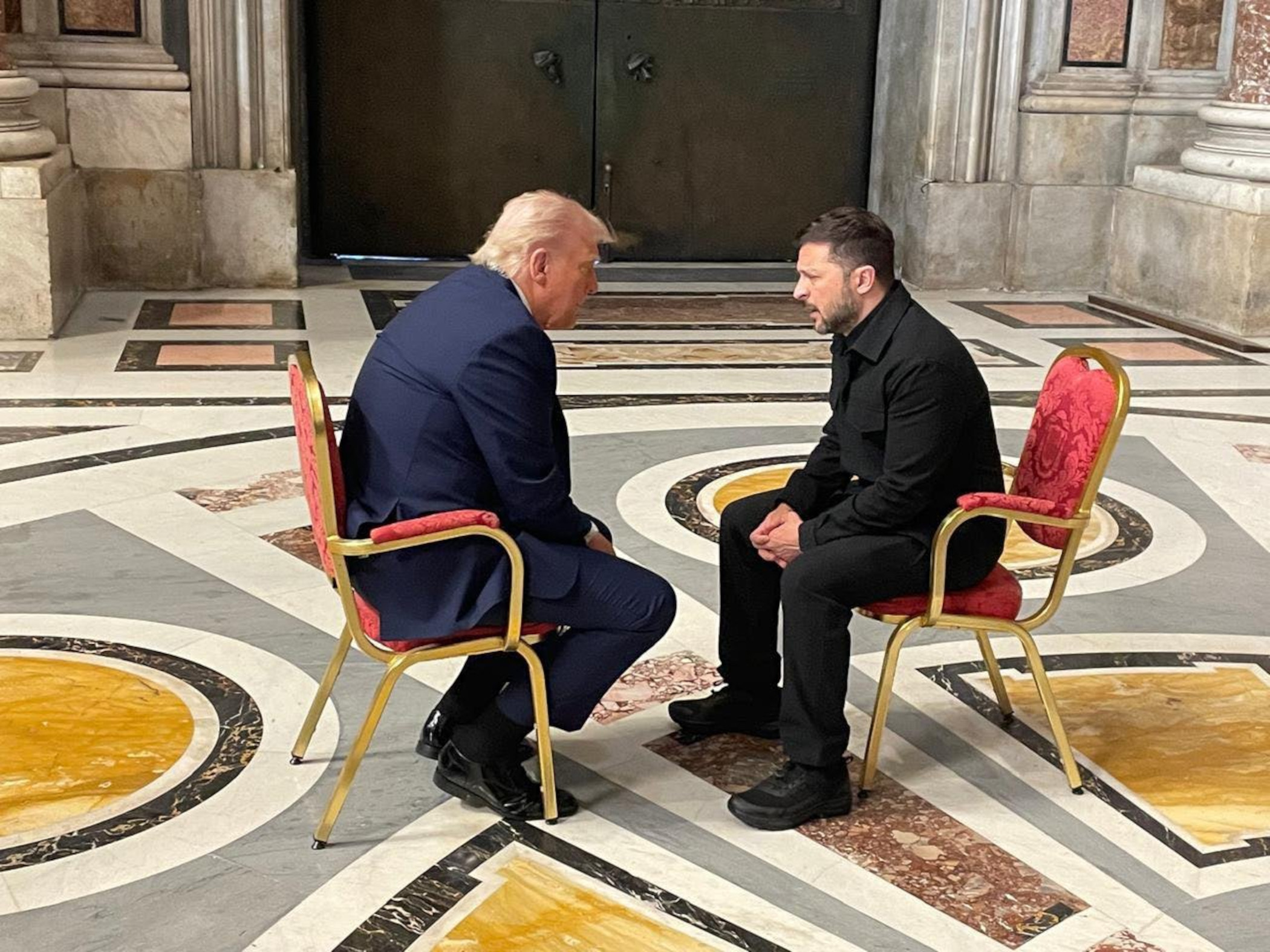
Zelenskyy and Trump meet inside St. Peter’s Basilica
Marco Levytsky, Editorial Writer.
After several months of torturous negotiations, Ukraine and the United States have officially signed a landmark minerals agreement, which is significantly more beneficial for Ukraine than the initial deal the Trump administration tried to foist upon Kyiv.
The most significant change is that the US has now dropped its demand that the first $500 billion of revenues generated from the contract be its own to keep. It had literally plucked this number out of thin air, claiming that it constituted repayment of military aid previously provided to Ukraine. Various other grossly inflated estimates of the dollar value of prior US aid were also bandied about by the Trump administration to justify this extortionate claim.
The facts, however, were quite different. Actual US aid to Ukraine totalled approximately $120 billion. And most of that was spent on production within the US (or consisted of deliveries of semi-obsolete inventory due to be scrapped). Ukrainian President Volodymyr Zelenskyy had rejected America’s earlier demands as being both unjustified and unduly onerous, explaining that it would take “10 generations of Ukrainians” to pay off such a crushing debt.
Instead, Kyiv and Washington have now agreed to jointly invest in a fund whose profits will be split 50-50 between the United States and Ukraine. This fund will be supported by the U.S. government through the U.S. International Development Finance Corporation agency, which Ukraine hopes will attract investment and technology from countries throughout the Americas and Europe. Ukraine is expected to contribute 50% of all future profits from government-owned natural resources into the fund. Contributions to the fund will be reinvested in projects related to mining, oil and gas as well as infrastructure. No profits will be taken from the fund for the first 10 years. This fund will also finance reconstruction efforts and future US military aid in the form of air defence. In this regard, Zelenskyy recently announced a desire to purchase 10 Patriot air defence systems.
Other key points:
- Ukraine will retain full ownership of all assets, including subsoil resources. Revenue sharing will be restricted to new licenses only, not legacy contracts.
- Profits from the critical minerals, oil, and gas industries will be included, but state-owned companies like Ukrnafta will remain under Ukrainian control.
- The deal covers minerals, including rare earth elements, but also other valuable resources, including oil and natural gas. It does not include resources that are already a source of revenue for the Ukrainian state. In other words, any profits under the deal are dependent on the success of new investments.
“We have formed a version of the agreement that provides mutually beneficial conditions for both countries. This is an agreement in which the United States notes its commitment to promoting long-term peace in Ukraine and recognizes the contribution that Ukraine has made to global security by giving up its nuclear arsenal,” Economy Minister Yulia Svyrydenko, who signed the deal for Ukraine, said in a post on Facebook.
So what prompted U.S. President Donald Trump to reverse course and drop his previous demands? One reason may be his growing frustration with Russian dictator Vladimir Putin’s refusal to accept the terms of the 30-day ceasefire and longer-term peace deal he had been proposing, and Putin’s continued massive missile attacks on Ukrainian civilians and civilian infrastructure.
Another reason, cited by the British newspaper The Telegraph, is the efforts of the United Kingdom’s Prime Minister Sir Keir Starmer, former PM Boris Johnson, and French President Emmanuel Macron, who worked behind the scenes to steer Trump away from his pro-Russian orientation and paved the way for the Trump-Zelenskyy meeting during Pope Francis’ funeral.
But the biggest credit must go to Zelenskyy himself and his negotiating team. Despite immense pressure from Trump, including a public humiliation unprecedented in the history of diplomacy, Zelenskyy remained resolute, composed and ultimately persevered. That 15-minute impromptu meeting inside St. Peter’s Basilica after the pope’s funeral proved to be pivotal. Speaking on May 1, Zelenskyy called the minerals deal a “historic” outcome of their April 26 conversation.
“It is now a truly equal agreement that opens the door to substantial investment in Ukraine and enables major modernization of production within the country, as well as, just as importantly, an upgrade of our legal practices,” he said.
The most significant shortcoming of this agreement, however, is that it contains no security guarantees for Ukraine once any ceasefire begins. Underpinning the agreement is the rather tenuous assumption that the mere presence of American contractors and investors in Ukraine will serve as a deterrent against further aggression.
It should also be noted that this is an economic deal and not a peace agreement. That remains as elusive as before. On May 2, the Trump administration announced it would step back from mediating Russia-Ukraine peace talks. Two days earlier Vice President JD Vance told Fox News the war “is not going to end any time soon.”
Moscow remains intransigent and continues to demand international recognition of the regions it has occupied over the past three years. Kyiv, meanwhile, has firmly rejected those terms, reiterating that Crimea remains Ukrainian territory. However, Putin must also deal with a collapsing economy. The price of Urals crude, which is Russia’s primary source for funding its war machine, has dropped from US$ 77 per barrel in January to $56 in April. As well, the liquid and usable reserves of its rainy-day fund have been depleted. Moscow is also suffering massive casualties. Russian forces managed to capture some 68 square miles of Ukraine in April. But it cost them 4,800 vehicles and more than 36,600 dead and wounded troops, according to one statistician who collects data mostly from official Ukrainian sources, including the general staff in Kyiv. In the same month, Ukrainian losses were “minimal,” stated analyst Konrad Muzyka of Rochan Consulting in Poland.
In these circumstances, it is critical for the democratic world to strengthen its military support for Ukraine in addition to tightening the sanctions on Russia. As a result of the minerals deal, the Trump administration has asked Congress to approve the sale of $50 million in defence-related products to Ukraine, according to the Kyiv Post. While this is a welcome policy change from the United States, nothing can ever be taken for granted where Trump is concerned. Therefore, it is still up to Europe and Canada to ensure that Ukraine receives the full support it needs to defeat Russia. It is not only Ukraine’s freedom and sovereignty that are at stake here, but also that of Europe and the rest of the democratic world.
Share on Social Media